
The short version
- Yes, visible engagement can make the same underlying content seem more worth choosing, more credible or more enjoyable — especially when people are unsure how good it is.
- The strongest evidence suggests social influence distorts the middle of the quality distribution more easily than the obvious extremes: excellent content still tends to do well and truly poor content rarely becomes a durable hit from social proof alone.
- Large metrics can create feedback loops. In one randomized field experiment, a single artificial positive rating increased later positive ratings and lifted final scores even though the underlying comment had not changed.
- The effect is not automatic. Meta-analyses find small average credibility effects, and some experiments find that likes do nothing while comments, source quality or the content itself matter more.
- Engagement is evidence that people reacted. It is not independent evidence that the content deserved the reaction.
Yes — especially in the uncertain middle
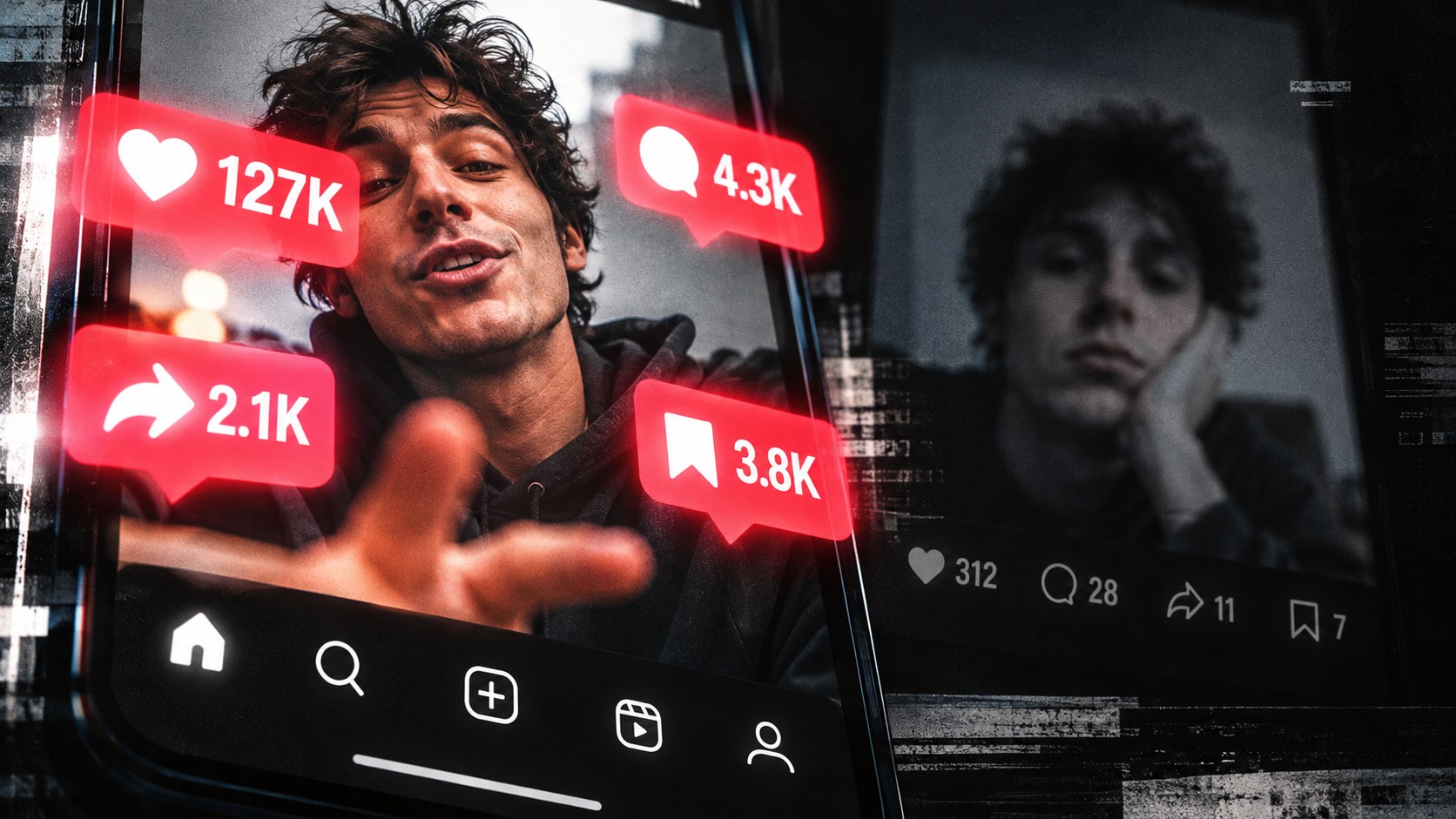
Put the same video in front of someone twice. In one version it has 43 views. In the other it has 430,000.
The pixels have not changed. The soundtrack has not changed. The argument has not changed. But the second version arrives with an extra piece of information: a crowd already chose this.
Research across music, news, ratings and online video suggests that visible popularity can change what people choose, how they rate it and, in some settings, how credible or enjoyable they find it. The effect is real enough to matter, but weaker and less universal than the phrase “social proof works” makes it sound.
The most defensible answer to this article’s question is yes, with a useful qualification.
Visible engagement is particularly good at helping middle-of-the-pack content outperform what its underlying quality would predict. It is much less convincing as a machine that can reliably turn obviously bad material into something people genuinely think is excellent.
That distinction matters because “mediocre” is where uncertainty lives.
Popularity can loosen the link between quality and success
One of the clearest demonstrations did not use TikTok, Instagram or YouTube. It used unfamiliar songs.
In a 2006 Science experiment, Matthew Salganik, Peter Dodds and Duncan Watts built an artificial music market and recruited 14,341 participants. Some people chose songs without seeing what previous participants had done. Others could see how popular the songs had already become.
When social-influence information was visible, success became both more unequal and less predictable. The researchers found that quality still mattered: the best songs rarely finished at the bottom and the worst rarely became the biggest hits. But between those extremes, many outcomes were possible.
That is close to the “mediocre content” problem in its cleanest form.
If an item is spectacular, it has a strong private signal working for it. If it is awful, the private signal works against it. A middling item gives the viewer less to go on. The crowd can fill more of that gap.
The study did not prove that every average piece of content can be made successful with a large number beside it. It showed something subtler and more important: once people can see what other people chose, popularity becomes one of the forces producing future popularity.
Quality is still in the system. It just stops being the only input.
One early nudge can become its own evidence
Seven years later, another Science experiment manipulated the social signal directly.
Lev Muchnik, Sinan Aral and Sean Taylor ran a large randomized field experiment on a social-news site. Some comments received an artificial positive rating, some an artificial negative rating and others were left alone.
The added positive rating increased the likelihood of the next positive rating by 32%. The effect accumulated: positively treated comments ended with ratings about 25% higher on average than controls.
Nothing about the underlying comment improved when that first vote appeared.
The number changed, then the crowd partly followed the number.
The negative manipulation behaved differently. Users tended to correct it rather than allowing the effect to compound in the same way. That asymmetry is useful because it shows that social influence is not simply mechanical copying. People still evaluate what they see.
But a small artificial advantage was able to become a real aggregate advantage.
That is the dangerous elegance of visible engagement. Once the first cue changes genuine behavior, the resulting engagement is no longer fake. It is a real response to a distorted starting condition.
View counts can affect the decision before the content is even consumed
A popularity cue does not need to change somebody’s opinion of a video after they watch it. It can win earlier.
W. Wayne Fu studied 1,223 user-generated videos and found that videos displaying higher view counts tended to attract more subsequent views. In other words, the visible audience itself helped generate a larger audience.
The interesting part was what weakened the effect.
When people had more useful information about the actual video — especially a thumbnail preview, and in some conditions more text — the popularity bandwagon became less powerful.
That fits the uncertainty explanation neatly.
If you can already judge whether something looks relevant or worthwhile, you need the crowd less. If the content is a mystery, “430,000 people watched this” becomes a cheap substitute for information you do not have yet.
This is why visible engagement can matter so much in feeds. The metric often appears before the full experience.
It gets a vote before the content does.
“Seem better” is actually four different outcomes
Research on social metrics becomes confusing when every response is treated as the same thing.
A large number can make a post more likely to be selected without making it more enjoyable. It can raise perceived credibility without changing agreement. It can trigger another like without changing what someone would say in a private review.
| Visible signal | What it can influence | What it does not establish |
|---|---|---|
| View count | Selection, attention, expected value | That viewers enjoyed it |
| Likes or ratings | Further likes, ratings, sometimes credibility | That the claim is true |
| Shares or reposts | Perceived reach or social importance | Agreement, expertise or accuracy |
| Comments | Attitude and credibility, depending heavily on what they say | That commenters represent the wider audience |
| Follower count | Perceived popularity or authority | Audience quality, attention or competence |
That distinction also matters when reading creator analytics. A visible metric describes a response captured by a platform. It does not automatically explain why the response happened or whether another measure would tell the same story.
Credibility moves too — but the average effect is small
The case becomes more interesting when the question moves from “Will people click?” to “Will people believe it?”
A 2023 meta-analysis in Communication Research combined 161 effect sizes from 41 studies. Bandwagon cues had a positive but small effect on credibility perceptions. The effect was stronger in some contexts, including marketing messages and messages from non-expert sources.
A newer 2026 meta-analysis covered 18 experimental studies with 14,188 participants. It estimated a small positive effect for social cues such as likes, shares and comments on perceived credibility: Hedges’ g = 0.185 for social cues. Source cues were stronger, at g = 0.407.
That is an important calibration.
Visible engagement can shift credibility. It is not usually the dominant force.
Who posted the information, what the information says, how relevant it is and what other people are saying can matter more than the raw count.
A 2017 experiment by Myojung Chung makes the boundary especially clear. Participants read the same kind of news story while the credibility of the news organization and the presence of social metrics were varied. The social metrics affected evaluations when the source was low-credibility, not when it was high-credibility.
Again, the crowd had more room to matter when the other signal was weak.
Sometimes the likes do absolutely nothing
Any clean story that says “high likes make people believe things” runs into experiments that do not reproduce that result.
In a 2015 study, 197 participants saw a Facebook post from a reputable news organization. Researchers varied both the number of likes and the comments underneath it. A high like count did not produce the expected conformity effect.
Negative comments did matter. They reduced the persuasive influence of the article.
That result is useful because comments contain information that a count does not. Ten thousand likes say that people pressed a button. A skeptical comment can give the reader an argument.
The interface may present both as “engagement,” but psychologically they are not interchangeable.
So the answer is not that people mindlessly obey any large number they see. It is that visible social information becomes one more cue in the judgment — and some cues are much more diagnostic than others.
Mediocre content may be the easiest content to socially upgrade
No single study in this literature takes a set of deliberately “mediocre” TikToks, pre-rates their quality, assigns fake engagement counts and then measures every downstream response we care about.
So this conclusion should be labeled correctly: it is a synthesis of the evidence, not a direct universal finding.
But the pattern is unusually consistent.
The artificial music market found that quality constrained the extremes while social influence made the middle much less predictable. Video research found that popularity cues mattered more when viewers had less information about the content itself. Credibility research finds small average bandwagon effects that can become stronger when source authority is weak.
Put together, that suggests a practical model:
- Excellent content has its own signal. People can often recognize value without needing the crowd to explain it.
- Terrible content has a strong negative signal. Popularity may win attention, but the content can still fail once experienced.
- Ambiguous or middling content leaves room for interpretation. A large visible audience can push the viewer toward “there must be something here.”
That third category is where social proof has the most room to rewrite expectations.
It does not need to make a mediocre post objectively better.
It only needs to make the viewer approach it as though it is probably worth something.
The metric changes the wrapper around the work
This is also why raw engagement is such a powerful status object online.
A post with 200,000 likes carries two messages at once: whatever the post itself says, and the fact that 200,000 visible reactions surround it. The second message can affect how the first is received.
The same mechanism helps explain why metrics can intensify online wealth and status signals. A screenshot, claim or flex can arrive with an audience already attached. The apparent consensus becomes another layer of presentation.
But the metric is still evidence of a narrower fact than people often ask it to prove.
A million views means a view counter reached a million. A large number of likes means many likes were recorded. Those observations may be relevant to popularity. They do not independently establish quality, truth, expertise or value.
That is the same discipline we use when evaluating screenshots as evidence: keep the conclusion proportional to what the visible record can actually support.
Popularity is not merely measured after consumption. Once it is visible, it can become an input to consumption.
That is the part worth remembering.
The cleaner experiment is still worth running
The existing literature gets close to the headline question, but a modern platform-specific experiment could answer it more directly.
Start by having one group evaluate a pool of short videos with all engagement hidden. Use those ratings to identify clear low-, middle- and high-quality bands. Then show new participants the same videos with randomly assigned low, high or hidden engagement counts.
Measure outcomes separately:
- whether they choose to watch;
- how long they stay;
- how good they say the content is afterward;
- how credible they find it where credibility is relevant;
- whether they like, save or share it.
The important interaction would be quality × visible engagement.
If social proof really upgrades mediocrity more than the extremes, the high-engagement treatment should produce its largest lift in the middle band.
That experiment would separate a claim people casually make about the internet from the more precise mechanism suggested by the evidence we already have.
Until then, the answer is strong enough to use but not strong enough to caricature:
visible engagement can make middling content perform and sometimes feel better than it otherwise would. It cannot be treated as a universal quality multiplier.
Sources & reference material
- Experimental Study of Inequality and Unpredictability in an Artificial Cultural MarketScience · Accessed Oct 09, 2026
Experiment with 14,341 participants showing that visible prior choices increased inequality and unpredictability in music success; quality only partly determined outcomes.
- Social influence bias: a randomized experimentScience · Accessed Oct 09, 2026
Randomized field experiment showing that an artificially added positive rating increased the probability of subsequent positive ratings by 32% and final ratings by 25% on average.
- Selecting Online Videos from Graphics, Text, and View Counts: the Moderation of Popularity BandwagonsJournal of Computer-Mediated Communication · Accessed Oct 09, 2026
Naturalistic analysis of user-generated video showing that higher visible view counts attracted additional views, while richer previews could weaken the popularity bandwagon.
- Not just numbers: The role of social media metrics in online news evaluationsComputers in Human Behavior · Accessed Oct 09, 2026
Experiment with 202 participants finding that social metrics affected news evaluations when the source had low credibility and reduced the gap between high- and low-credibility sources.
- Do Bandwagon Cues Affect Credibility Perceptions? A Meta-Analysis of the Experimental EvidenceCommunication Research · Accessed Oct 09, 2026
Meta-analysis of 161 effect sizes from 41 studies finding a positive but small effect of bandwagon cues on credibility perceptions, with meaningful moderators.
- How Heuristic Credibility Cues Shape Perceived Credibility on Social Media: A Meta-Analysis of Experimental ResearchBehavioral Sciences · Accessed Oct 09, 2026
Meta-analysis of 18 experimental studies with 14,188 participants; social cues had a small positive pooled effect on perceived credibility and were weaker than source cues.
- They Came, They Liked, They Commented: Social Influence on Facebook News ChannelsCyberpsychology, Behavior, and Social Networking · Accessed Oct 09, 2026
Experiment with 197 participants finding no conformity effect from a high number of likes, while negative comments reduced the persuasive influence of the article.