
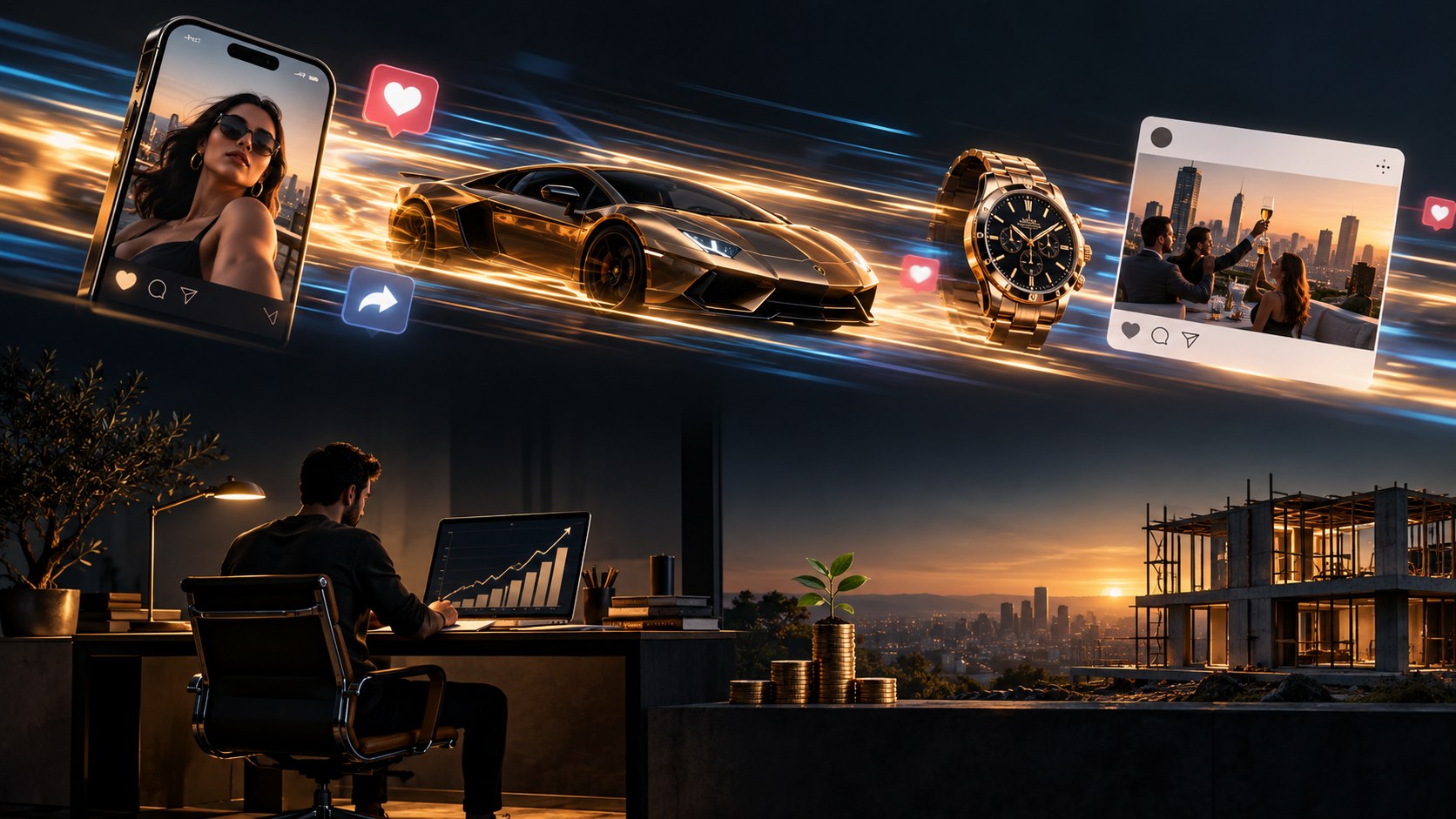
The short version
- Flex culture is the public performance of status through visible cues such as luxury goods, experiences, access, financial screenshots and audience metrics.
- A wealth signal is information: it can be photographed, compressed, reposted and copied without reproducing the wealth that originally made the signal meaningful.
- Social platforms distribute content according to audience-response signals, not by auditing whether the lifestyle shown is representative, owned or financially sustainable.
- Visible approval — likes, comments, views and followers — can add a second layer of status to the original flex, turning attention itself into another thing worth displaying.
- Obvious flexing can also backfire, which helps explain why status signaling increasingly includes subtle cues of access, taste, time, networks and competence rather than only loud luxury.
Flex culture is not the same thing as fake wealth
A Rolex on a wrist. A steering wheel with the right badge. A first-class cabin. A payment notification. A trading P&L. A restaurant table positioned just carefully enough to include the bag.
These are all versions of the same act: turning status into something an audience can see quickly.
That is flex culture.
It overlaps with fake wealth, but the two are not identical. A flex can be completely real. The car can be owned. The hotel can be paid for. The number on the screen can be accurate. The performance begins one step earlier than deception: with the decision to convert some advantage into a visible social signal.
The internet changed the economics of that signal.
Actual wealth is difficult to accumulate, often private and impossible to duplicate simply by looking at it. A wealth signal is information. Once it becomes an image, clip, screenshot or recognizable format, it can be copied across millions of screens without multiplying the money behind it.
That is why a feed can become saturated with the appearance of wealth even when the distribution of wealth underneath it has barely changed.
The signal scales. The asset does not.
Wealth has to exist somewhere. The image only has to travel.
A $200,000 car can only be in so many places at once.
A ten-second video of it can appear on ten million phones.
This sounds obvious, but it changes status culture in a fundamental way. Before mass visual media, expensive objects were constrained by physical proximity. You usually had to encounter the house, clothes, car, club or neighborhood to receive the signal.
Social media turns the object into media.
Once that happens, the scarce part and the visible part split apart:
| Underlying thing | What the feed receives |
|---|---|
| A valuable car | A recognizable badge, interior and sound |
| A luxury trip | A seat, lounge, hotel view or boarding moment |
| A profitable business | A revenue number, notification or dashboard |
| Financial wealth | A balance, P&L or purchase |
| Social access | A room, event, guest list or recognizable person |
| Time and autonomy | A weekday golf round, long lunch or “work from anywhere” clip |
The audience rarely receives the entire economic reality. It receives the most legible fragment.
Research on conspicuous consumption has repeatedly found that those fragments can carry status meaning. In a 599-person experiment, luxury goods and some luxury experiences produced higher status perceptions than non-luxury experiences.
The signal does not need to contain a balance sheet. It needs to be recognizable.
That recognition is what makes it portable.
The flex became a content format
The most important change is that status display is no longer merely something people do inside content.
It can be the content.
Lucia Bainotti’s research on Instagram micro-influencers describes a shift from conspicuous consumption as simple expenditure toward what she calls a more productive form of conspicuousness. In her study, displays of goods, services, access and exclusivity were part of the work of constructing status itself. The research combined 765 Instagram Stories from 10 micro-influencers with interviews involving 35 creators. The display was not merely evidence of status; it could help produce and maintain status.
That distinction explains a lot of modern flex culture.
The watch is not only a watch. It is a thumbnail.
The holiday is not only a holiday. It is a sequence of posts.
The car is not only transportation. It is a recurring background, an opening shot, a piece of visual shorthand.
Consumption becomes raw material for publishing.
Once that happens, there is an incentive to choose status signals that read well on camera. A financially responsible decision that improves someone’s net worth may be almost invisible. A luxury purchase that weakens their finances can be spectacular content.
The feed therefore has no reason to reflect the things that actually make people wealthy in proportion to their importance.
Compound returns are boring footage. A Lamborghini door is not.
Platforms can rank the reaction without verifying the lifestyle
Recommendation systems do not need to decide whether someone is genuinely rich to decide whether a post is worth showing again.
YouTube, for example, publicly describes three broad performance-signal categories in its recommendation guidance: appeal, engagement and satisfaction. It asks whether viewers choose to watch, whether they keep watching and whether they appear to enjoy the result. The system is evaluating audience response to the content, not auditing the creator’s net worth.
That is one platform’s public description, not a universal specification for every feed. But it illustrates the basic mismatch.
The platform can observe that a clip made people stop, watch, comment or share.
It usually cannot know from that response alone whether:
- the car is owned, financed, borrowed or rented;
- the trip represents an ordinary week or one unusual weekend;
- the revenue number is gross, net, recurring or cherry-picked;
- the trading result is representative or exceptional;
- the expensive object was a sensible purchase or a financial mistake.
Those facts may matter enormously if the post is being used as proof of expertise or financial success. They are not required for the media object to perform well as media.
That creates an information asymmetry built for flex culture: attention can be measured immediately; underlying wealth is much harder to verify.
Our analysis of why fake wealth works online deals with the more deceptive edge of that gap. Flex culture is broader. It includes honest status display, selective status display and completely manufactured status display competing inside the same visual language.
A flex can collect a second flex on top of it
The first signal is the car.
The second signal is that 1.8 million people watched the car.
Social platforms make audience response visible: views, likes, comments, shares, follower counts, verification markers. These metrics can become status objects in their own right.
A 2026 meta-analysis covering 18 experimental studies and 14,188 participants found that source and social heuristic cues can affect perceived credibility, though the size of the effect varied and source cues were stronger than social cues overall. Popularity-style indicators are not proof, but people do use visible cues when making fast judgments online.
That can produce a reinforcing stack:
wealth signal → attention → visible engagement → stronger perceived status → more attention
The original object is no longer doing all the work.
A creator can flex the reaction to the flex.
Screenshots make this especially efficient. A payment total, audience graph or trading result looks precise because it arrives wrapped in interface language. But, as with any screenshot used as proof, the frame can establish much less than the story built around it.
Now the status signal is compact enough to fit in a phone screen and the social proof is printed around it by the platform itself.
Flex culture is imitable even when the wealth is not
A billionaire’s net worth is difficult to reproduce.
A billionaire-coded video is much easier.
This matters because internet culture copies formats faster than it copies outcomes. Once viewers understand the grammar of a flex, they can reproduce pieces of it at lower cost:
- a luxury rental instead of ownership;
- one business-class upgrade instead of routine private travel;
- one winning trade instead of a long profitable record;
- a designer item financed over time;
- a screenshot of revenue without the costs below it;
- a premium hotel lobby without a premium hotel room;
- access to an event without lasting access to the network around it.
Again, none of those things is automatically fake. A rented car can simply be a rented car. The cultural effect comes from standardization. Once the audience knows what success is supposed to look like, more people can reproduce the visible language of success without reproducing the same balance sheet.
A 2025 Journal of General Psychology experiment involving 2,296 Instagram users explicitly studied “flexing” and conspicuous consumption. Participants exposed to a material-purchase post reported higher materialistic aspiration than those shown an experiential-purchase post, while anticipated audience engagement was also part of the relationship the researchers examined. The work is one piece of evidence that status content is not only observed; it can shape what viewers aspire toward.
A separate 2024 survey study found links between influencer exposure, social comparison, desire to mimic, FOMO, materialism and conspicuous consumption. Its design does not prove that every influencer causes followers to buy status goods, but it fits a wider pattern: visible lifestyles can become comparison targets and templates.
The content is doing cultural replication long before it is doing economic replication.
The feed can make rare lives look common
Suppose only a small fraction of people can afford a certain lifestyle.
That does not mean only a small fraction of the posts you see will depict it.
A feed is not a random sample of society. People choose what to publish. Audiences choose what to watch. Recommendation systems reorder the result. Creators learn what travels. Brands pay for aspiration. Successful formats get repeated.
By the time the viewer sees the final stream, several filters have already favored visibility over representativeness.
This is where flex culture can quietly distort the baseline.
You do not need to believe that every person online is rich. You only need to encounter enough luxury apartments, trips, watches, businesses and screenshots that an unusually high-consumption life begins to feel culturally ordinary.
The mechanism is not “social media makes everyone stupid.” It is simpler:
visible examples occupy more mental space than invisible counterexamples.
The person quietly increasing their pension contribution is not likely to become a recurring visual archetype. Neither is the founder with healthy margins who drives an old car, the trader who sits out a bad market, or the high earner who does not post income.
Their wealth can be real and almost contentless.
Flex culture selects for the opposite.
Actual rich people do not all flex the same way
There is another mistake worth avoiding: assuming that obvious luxury display is a reliable marker of actual wealth, or that genuinely wealthy people never display status.
Both ideas are too neat.
A study of 815 public Instagram images posted by ultra-high-net-worth individuals found a mix of self-presentation styles, including more subtle displays of luxury possessions, experiences, power and social connections. Status could be communicated through access and context rather than only loud logos or overt extravagance.
This is why flex culture evolves.
When a signal becomes too easy to copy, sophisticated status signaling can move toward harder-to-read cues: the restaurant reservation, the school, the neighborhood, the niche watch, the private event, the absence of visible work, the people in the room.
The flex gets quieter without disappearing.
In fact, subtlety can itself become a status claim: I do not need to show you the logo because the right people already know what this is.
That is still signaling. It simply demands more cultural knowledge from the audience.
Loud flexing can also damage the person doing it
Status cues attract attention, but admiration is not guaranteed.
In three studies published in 2024, people who saw others sharing luxury consumption inferred stronger self-presentational motives and weaker self-expressive motives. Those inferences reduced perceived authenticity and interpersonal interest. The negative effect was smaller when the post emphasized competence rather than wealth. A luxury signal can raise status while simultaneously making the poster look more performative.
This helps explain the strange tone of modern flex culture.
The successful flex often wants to be seen without looking like it was designed to be seen.
The expensive watch is “accidentally” in frame.
The business-class seat appears in a work update.
The revenue number arrives inside a lesson about entrepreneurship.
The desirable social circle appears in a casual photo dump.
Status display survives, but it borrows the language of documentation.
The performance works best when the audience can tell what the signal means without feeling that the signal is shouting at them.
Flex culture is a distribution problem before it is a truth problem
The obvious question around online wealth is often: Is it real?
That matters when someone is making a factual financial claim, selling expertise or asking for money. But it is not the first question flex culture raises.
The first question is why the signal is everywhere.
The answer is that the visible unit of wealth behaves differently from wealth itself.
Actual wealth can be concentrated, private, illiquid, inherited, leveraged, temporary or invisible. Its representations are small media objects: a frame, a number, a logo, a location, a purchase, a person, a metric.
Those objects are easy to publish, rank, remix and imitate.
So the internet can create an abundance of wealth imagery without creating an abundance of wealth.
That does not make every flex fraudulent. It makes the feed a poor census.
The useful response is not to assume that every luxury post is fake. It is to keep three layers separate:
- The object: what is visibly present?
- The claim: what does the post imply about the person’s wealth, success or expertise?
- The distribution: why did this particular signal reach you instead of the thousands of financially ordinary moments that did not become content?
Once those layers are separated, flex culture becomes easier to read.
The car may be real.
The money may be real.
The audience may be real.
What is almost never safe to assume is that the feed shows those things in proportion to how common they actually are.
Wealth does not go viral. Its symbols do.
Sources & reference material
- How conspicuousness becomes productive on social mediaMarketing Theory / SAGE Journals · Accessed Oct 10, 2026
Qualitative and digital-methods research on Instagram micro-influencers showing how displays of consumption can become productive tools for constructing and maintaining social status.
- Someone just posted on Instagram: Conspicuous consumption, anticipated engagement, and trait mindfulnessThe Journal of General Psychology / PubMed · Accessed Oct 10, 2026
Experiment with 2,296 Instagram users examining flexing, material versus experiential luxury posts, anticipated engagement and materialistic aspiration.
- Conspicuous consumption of luxury experiences: an experimental investigation of status perceptions on social mediaJournal of Product & Brand Management · Accessed Oct 10, 2026
599-participant experiment comparing status perceptions produced by luxury goods, luxury experiences and non-luxury experiences in an Instagram-style setting.
- Understand your content performance for YouTube’s recommendation systemYouTube Help · Accessed Oct 10, 2026
YouTube describes appeal, engagement and satisfaction as performance-signal categories used to predict whether viewers will watch and enjoy content.
- How Heuristic Credibility Cues Shape Perceived Credibility on Social Media: A Meta-Analysis of Experimental ResearchBehavioral Sciences / PubMed · Accessed Oct 10, 2026
Meta-analysis of 18 experimental studies involving 14,188 participants finding that source and social heuristic cues can affect perceived credibility, with effects varying by cue and audience.
- Sharing luxury consumption on social media platforms: Motive inferences and downstream consequencesJournal of Consumer Behaviour · Accessed Oct 10, 2026
Three studies finding that luxury-sharing posts increased inferred self-presentational motives and reduced perceived authenticity and interpersonal interest, with weaker negative effects when competence was emphasized.
- Ultra-high-net-worth individuals: self-presentation and luxury consumption on InstagramEuropean Journal of Marketing · Accessed Oct 10, 2026
Content analysis of 815 public Instagram photos from ultra-high-net-worth individuals identifying subtle displays of possessions, experiences, power and social connections alongside overt forms of luxury self-presentation.
- Social media influencers and followers’ conspicuous consumption: The mediation of fear of missing out and materialismHeliyon · Accessed Oct 10, 2026
Survey study of 272 respondents linking influencer exposure with social comparison, desire to mimic, FOMO, materialism and conspicuous-consumption outcomes.