
The short version
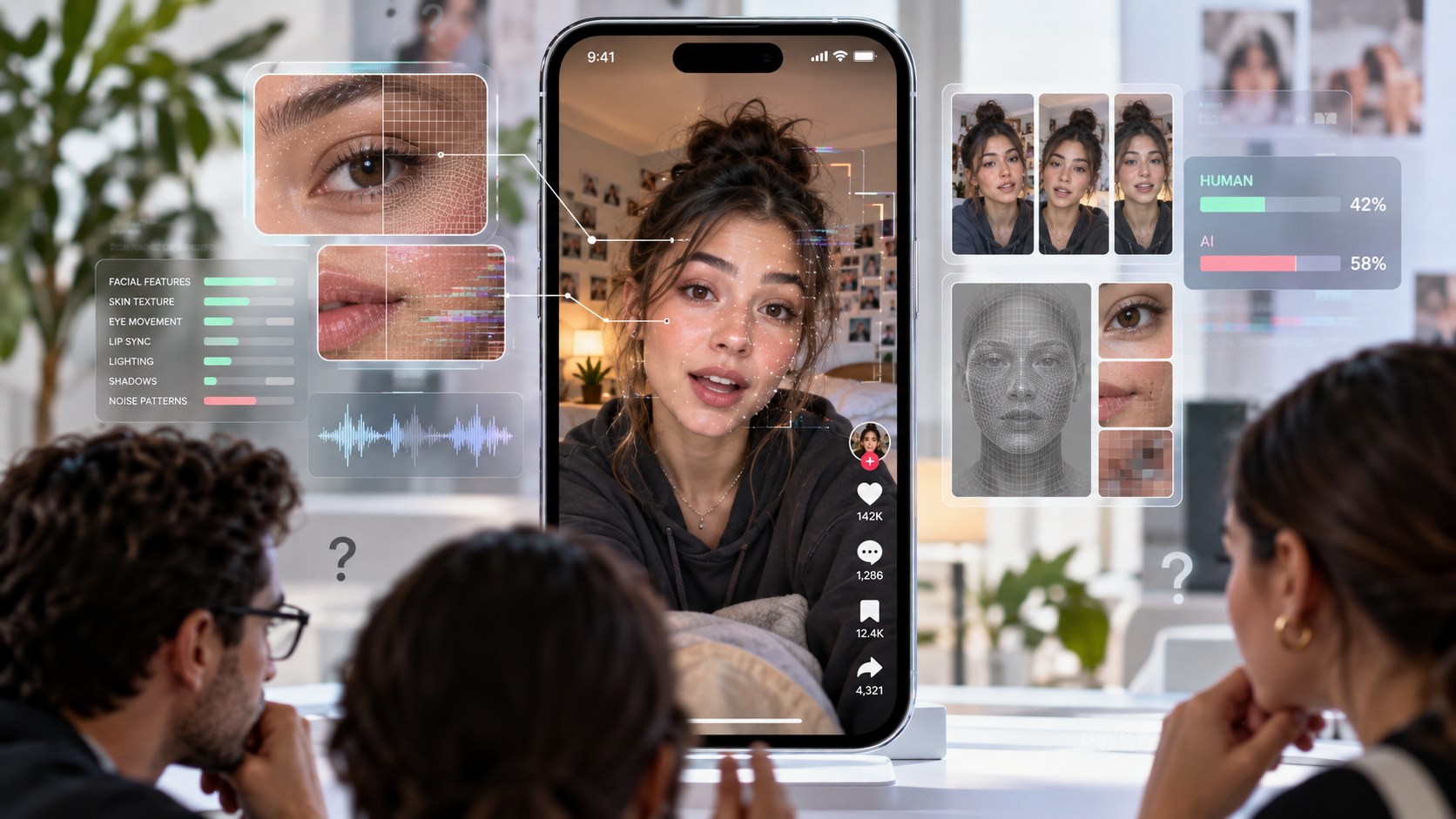
- There is no single reliable detection rate for AI-generated UGC video; performance changes sharply with the generator, scene, format and viewing time.
- In a 2026 study using Veo 3.1, Sora 2 and Seedance Pro 1, detection of AI-generated video rose from 57.7% from a first frame to 74.6% after eight seconds, while recognition of authentic video stayed around 60%.
- A separate 2025 study found 60% overall accuracy, but text-to-video clips were identified correctly only 43% of the time while image-to-video clips were identified 79% of the time.
- Research on UGC-style deepfake ads shows that viewers sometimes recognize synthetic creators spontaneously and can improve with priming, but it does not establish a universal UGC detection rate.
- Visual clues are useful for suspicion, not proof. Provenance, disclosure and source context are stronger evidence than whether a clip simply 'looks AI.'
The answer depends on what kind of “AI UGC” you mean
Yes, people can identify some AI-generated UGC videos. No, they cannot do it reliably enough to treat their eyes as an authenticity detector.
The research is messy because “AI UGC” is not one technical format.
A synthetic talking-head testimonial, a fully generated text-to-video clip, an image animated into video, a face-swapped ad and a real creator whose voice has been cloned can all be marketed as AI UGC. They leave different clues. A study using one of those formats cannot automatically tell us how people will perform on all the others.
That distinction matters more now because the gap between generators is large. In one recent experiment, people were reasonably good at catching output from one model and much worse with another. In another, the generation method mattered enough to move detection from below chance to nearly 80%.
So the useful question is not simply “can humans spot AI video?”
It is: under what conditions, using what kind of video, and with what kind of mistakes?
One 2026 experiment found that more video helps — but creates a second problem
A 2026 CVPR workshop study by Catherine Davodi, Sarah Barrington, Hany Farid and Emily Cooper tested 376 participants on authentic footage and clips generated by Google Veo 3.1, OpenAI Sora 2 and ByteDance Seedance Pro 1.
The researchers matched 24 scene types across real and generated footage. Half involved people; half did not. Participants saw clips at different durations ranging from a single first frame to eight seconds, then answered a simple question: real or AI-generated?
With only the first frame, participants correctly identified AI-generated material 57.7% of the time.
At eight seconds, that rose to 74.6%.
That sounds like a strong win for human detection. The stranger result is what happened to real video.
Participants identified authentic footage correctly about 60% of the time from the first frame, and extra viewing time did not produce a sustained improvement. Longer clips made people better at rejecting synthetic footage, but not better at confirming that genuine footage was genuine.
The researchers describe a shift toward skepticism: more motion gave viewers more opportunities to find something suspicious.
That is an important distinction. A person who becomes better at saying “fake” is not necessarily becoming equally good at determining what is real.
| What changed with more viewing time? | Result |
|---|---|
| Detecting AI-generated clips | Improved substantially |
| Correctly accepting authentic clips | Stayed roughly flat |
| Confidence when detecting AI | Became better calibrated |
| General response tendency | Shifted toward greater skepticism |
The study also found huge variation between individual clips. Accuracy ranged from 19% to 95% depending on the video.
There is no single human “AI video detection ability” hiding underneath those numbers.
The generator can matter almost as much as the viewer
The same 2026 study found that participants identified Seedance-generated clips as synthetic 77.8% of the time across durations. Veo was detected at 65.7% and Sora at 62.0%.
A separate 2025 IASDR study makes the variation even clearer.
Researchers showed 87 participants 36 videos: 18 real and 18 AI-generated. The synthetic set included Google Veo 3, Lightricks LTX Video and Wan VACE, spread across text-to-video, image-to-video and video-outpainting techniques.
Overall accuracy was 60%.
But that average hides the useful part:
| Video type | Correctly identified |
|---|---|
| Image-to-video | 79% |
| Real footage | 64% |
| Video outpainting | 49% |
| Text-to-video | 43% |
In that experiment, people were actually worse than chance at identifying the text-to-video clips as synthetic.
The same viewer can therefore look perceptive in one test and gullible in another simply because the generation pipeline changed.
This is why claims such as “people can spot AI video 75% of the time” age badly. The number belongs to a particular model set, stimulus set, task and moment in the technology cycle.
The older deepfake literature is even less reassuring
Modern generative video is not the same thing as the classic deepfake literature. Older studies often focused on face swaps, manipulated talking heads or identity-based synthetic media rather than the fully generated short-form clips now appearing in feeds.
Still, the broader evidence is useful as a baseline.
A 2024 systematic review and meta-analysis combined 56 papers involving 86,155 participants. Across modalities, human deepfake detection was not reliably above chance. For video specifically, the pooled rate for correctly identifying deepfake video was 57.31%, with a confidence interval that crossed 50%.
The exact pooled number should not be pasted onto 2026 AI UGC. The underlying studies span different technologies and eras.
What it does show is that humans have never had a particularly dependable built-in detector for synthetic media. Better generators are arriving on top of an already weak baseline.
UGC-style video has been studied directly — but not enough to give it one number
The most directly relevant research is a 2026 paper titled “Caught in the Act”, which examined deepfake UGC-style advertisements.
Across three experiments, researchers compared people who spontaneously recognized a synthetic UGC ad with those who did not, people who learned about the deepfake after disclosure, and participants who were primed to think about deepfake content before exposure.
Two findings matter here.
First, natural recognition happened. Some viewers independently concluded that the peer-style ad was synthetic rather than needing to be told.
Second, priming participants about deepfakes made natural recognition more likely.
But this paper is more useful for understanding the consequences of recognition than for producing a universal detection score. It does not justify saying that a fixed percentage of people can spot “AI UGC” in the wild.
That question still needs more direct testing with the videos people actually encounter: vertical framing, phone-sized playback, captions, compression, background music, fast scrolling, synthetic spokespeople and ordinary-looking product testimonials.
Laboratory detection tasks are cleaner than a TikTok feed.
A vendor test produced one of the hardest recent benchmarks
There is another result worth taking seriously, with an obvious caveat.
In January 2026, Runway published The Turing Reel, a study using its own Gen-4.5 model. It recruited 1,043 participants. Each person saw 20 five-second clips — 10 real and 10 generated — and classified each as real or AI.
Overall accuracy was 57.1%.
Only 99 participants, or 9.5%, reached the study’s threshold for statistically significant individual accuracy: at least 15 correct answers out of 20.
The generated clips were created from the first frames of real source videos, with one generation per source and no cherry-picking or post-processing according to Runway’s published methodology.
That is a useful current benchmark.
It is also research published by the company whose model is being evaluated. It should not carry the same evidentiary weight as independent peer-reviewed work, and the result should not be generalized to every AI video system.
Still, it points in the same direction: at the realistic end of current generation, a short clip can become very difficult to classify by sight alone.
What people actually look for
In the Davodi study, participants most often described looking at motion, people and body parts, and image quality.
That matches the familiar folk checklist: hands, faces, teeth, eye movement, object interactions, impossible physics, strange textures and inconsistent motion.
Those cues are real. They are also moving targets.
The 2026 experiment found that AI-generated clips containing human motion were easier to identify than non-human scenes. Human bodies still gave viewers useful opportunities to catch errors.
But the study also found that participants who used those kinds of strategies were not automatically the best detectors. Knowing the standard checklist is different from applying it accurately to a polished clip.
There is another problem: a perfectly ordinary real video can contain “AI-looking” defects.
Phone cameras smear motion. Social platforms compress faces. Stabilization bends backgrounds. Beauty filters alter skin. Low light destroys hands. Aggressive sharpening produces halos. Frame interpolation can create strange movement.
A suspicious artifact is evidence to investigate. It is not a verdict.
The same principle applies to screenshots and context: a visual object can be genuine while the claim attached to it is false, or look suspicious while being entirely real.
Why UGC may be an especially awkward detection problem
UGC is built around imperfection.
A polished commercial is expected to have controlled lighting, clean audio and deliberate framing. A UGC-style ad is expected to look like somebody picked up a phone and started talking.
That means some of the properties people normally treat as signs of authenticity — handheld framing, casual speech, a messy room, uneven lighting, minor camera errors — can also be deliberately generated or simulated.
At the same time, the rough format can make genuine artifacts harder to interpret. If a face briefly smears during a fast phone movement, is that a generation failure or ordinary compression? If speech feels slightly unnatural, is it a synthetic avatar, a nervous human, a dubbed clip or aggressive noise removal?
Current published research does not give a clean estimate for how much the UGC aesthetic itself changes detection accuracy.
That gap should stay visible. It is better than pretending that a text-to-video benchmark answers a TikTok-ad question perfectly.
Recognition and trust are not the same problem
The most interesting result across this research may be the growing risk of false suspicion.
The 2026 Davodi study did not show viewers steadily learning to verify reality as clips got longer. It showed them finding more reasons to reject synthetic clips while their ability to accept real footage stayed around the same level.
That produces two possible errors:
- Synthetic video is mistaken for real.
- Real video is dismissed as synthetic.
The second problem becomes more serious as public awareness rises.
If every odd hand movement becomes “proof of AI,” authentic footage can lose evidentiary value too. Better detection literacy cannot simply mean teaching people to distrust more aggressively.
It has to include knowing when visual inspection has reached its limit.
For important claims, provenance beats vibes
If the stakes are low — a meme, a strange ad, a creator clip — visual judgment may be all a viewer wants.
If the video is being used as evidence, the standard should be higher.
The C2PA Content Credentials standard is one attempt to move the question away from appearance and toward provenance: what created a file, what happened to it and whether signed origin information survives.
Provenance is not magic. Metadata can disappear when files are re-encoded, screenshotted or moved through systems that do not preserve it. A missing credential does not prove AI generation, and a valid origin record does not prove the claim shown in the video is true.
But it is a better category of evidence than “the fingers looked weird.”
Source account, original upload, capture history, corroborating footage, disclosure and provenance can all matter more than aesthetic intuition.
So, can people identify AI-generated UGC videos?
Sometimes — and under the right conditions, surprisingly well.
Longer viewing time can expose motion failures. Human subjects can create more opportunities for artifacts. Training or priming can make viewers more sensitive. Some generators are still much easier to catch than others.
But there is no stable human detection rate for “AI UGC.”
Recent studies range from near-chance performance to strong detection depending on the material. One modern experiment found that more viewing time helped people catch AI without making them much better at recognizing real footage. Another found text-to-video clips were identified correctly just 43% of the time. A model-maker’s own benchmark landed at 57.1% overall.
The cleanest conclusion is narrower than either side of the hype:
People can notice synthetic video. They cannot reliably authenticate video by sight alone.
Sources & reference material
- Perceptual Judgments of Video Authenticity: An Examination of Viewing Duration, Confidence, Content, and StrategiesIEEE/CVF Conference on Computer Vision and Pattern Recognition Workshops · Accessed Oct 10, 2026
Primary 2026 experiment on human classification of authentic versus state-of-the-art text-to-video footage, including effects of duration, content and confidence.
- Synthetic Realities: Evaluating Human Ability to Distinguish AI-Generated Videos from Real FootageIASDR 2025 · Accessed Oct 10, 2026
Study of 87 participants comparing real footage with text-to-video, image-to-video and video-outpainting outputs.
- Human performance in detecting deepfakes: A systematic review and meta-analysis of 56 papersComputers in Human Behavior Reports · Accessed Oct 10, 2026
Meta-analysis of 56 papers and 86,155 participants finding human deepfake detection was not reliably above chance across modalities, including video.
- Caught in the Act: Natural recognition of deepfake UGC ad, expectancy violation and consumer responsesJournal of Retailing and Consumer Services · Accessed Oct 10, 2026
Three experiments on spontaneous recognition of deepfake UGC-style advertisements, post-disclosure recognition and the effect of priming.
- The Turing ReelRunway · Accessed Oct 10, 2026
Vendor-run study of 1,043 participants classifying real footage versus Gen-4.5 image-to-video outputs; useful as a current model-specific benchmark with clear conflict context.
- C2PA SpecificationsCoalition for Content Provenance and Authenticity · Accessed Oct 10, 2026
Official specification source for Content Credentials and media-provenance standards.