
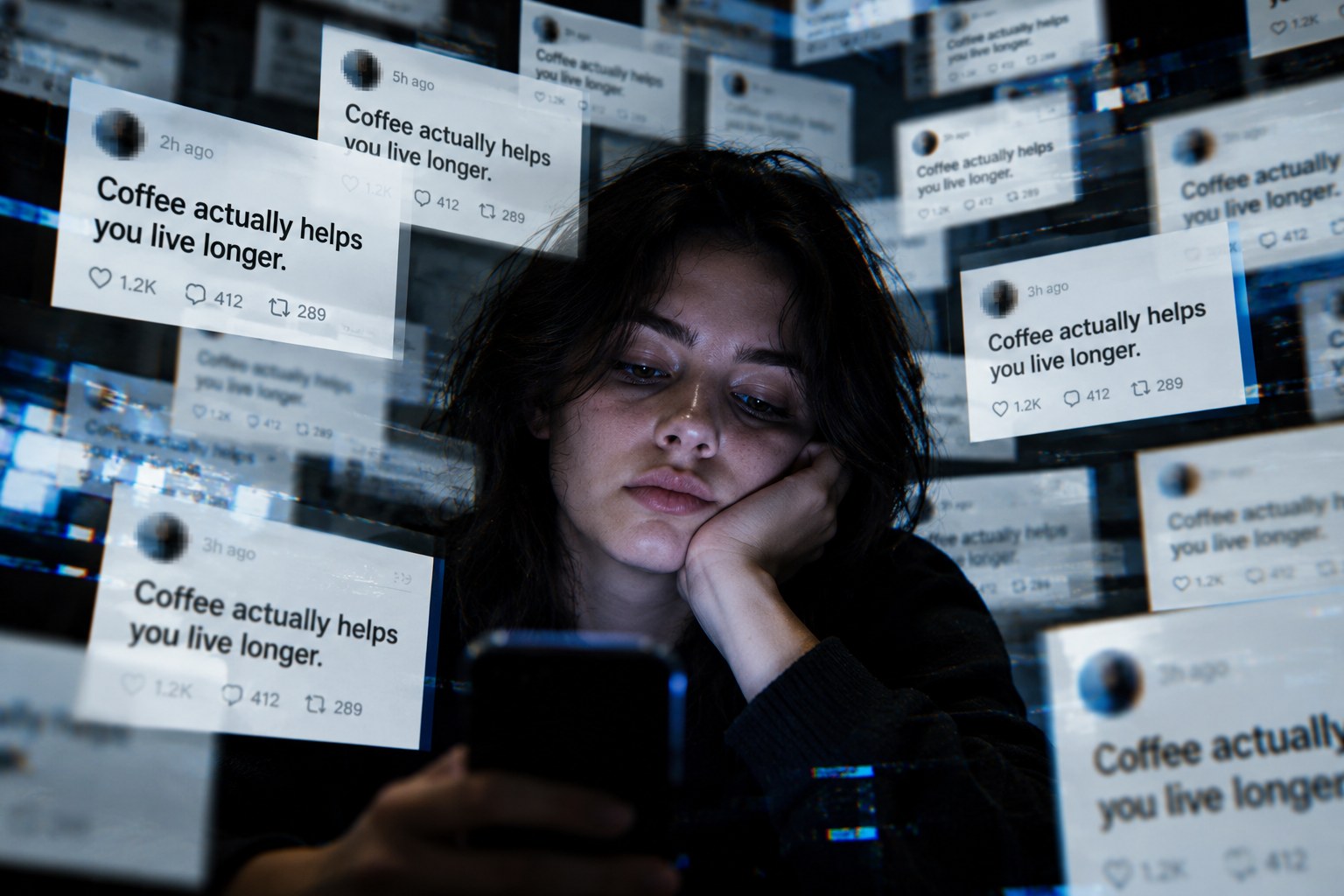
The short version
- Yes. Repeated claims are generally rated as more true than otherwise comparable claims seen for the first time, a finding known as the illusory truth effect.
- A 2026 meta-analysis covering 182 studies found a small but robust average effect after correcting for small-study effects.
- The first repetition appears especially important: experiments using many repetitions found the largest increase in perceived truth between the first and second encounter, with smaller gains afterward.
- Prior knowledge helps but is not a perfect shield; repetition can still shift truth ratings for some claims that conflict with what people know.
- Actively evaluating accuracy during the first encounter, checking the source and using clear truth or falsehood cues can reduce the effect.
Yes. Familiarity can start to feel like evidence.
A claim does not become true because you have seen it five times.
But it can become easier to believe.
Psychologists call this the illusory truth effect: people tend to rate repeated statements as more truthful than comparable statements they are encountering for the first time. The effect has been demonstrated with trivia, news headlines, misinformation and other kinds of claims.
The cleanest current estimate comes from a 2026 systematic review and meta-analysis covering 182 studies, 366 effect sizes and 31,184 participants. After adjusting for small-study effects, the researchers found a small but robust repetition-induced increase in perceived truth.
That wording matters. Repetition is not a mind-control switch, and the research does not show that hearing a lie often enough makes everyone accept it. It shows something subtler and more useful for understanding the internet:
Previous exposure can move a claim in the direction of feeling true, even when no new evidence has appeared.
The effect has survived nearly 50 years of testing
The basic result is old.
In a 1977 experiment, Lynn Hasher, David Goldstein and Thomas Toppino asked participants to judge the truth of plausible statements across three sessions separated by two weeks. Some statements returned; others did not.
Ratings increased for the repeated statements — including repeated false ones — while the non-repeated statements did not show the same change.
That study became one of the foundations of illusory-truth research. The 2026 meta-analysis in Nature Communications suggests the phenomenon is not a historical curiosity. Across decades of later experiments, repeated information still received higher truth ratings on average.
The pooled standardized effect was g = 0.37 after bias correction. That is not an enormous effect. It is large enough to be reliable and small enough that context still matters.
This is not “say anything enough times and everyone believes it.”
It is closer to: repetition quietly changes one of the signals people can use when deciding what feels true.
Why does repetition work?
There is no single settled mechanism that explains every version of the effect.
One prominent account is processing fluency. Something encountered before is generally easier for the brain to process again. That ease can be misread as a property of the claim itself: it feels familiar, coherent and less effortful, so it receives a small credibility advantage.
Another account focuses on referential coherence. Repetition may strengthen the connections among the ideas represented in a statement, making the claim easier to retrieve and mentally reconstruct later.
Either way, the dangerous part is the same: familiarity and evidence are different things, but they can produce similar subjective feelings.
You may not consciously think, “I have heard this before, therefore it is true.”
You may simply experience the second encounter as less strange.
That is enough to matter.
The second encounter may do more work than the twentieth
More repetition can increase perceived truth, but the increase is not linear.
In two experiments published in 2021, participants encountered trivia statements at frequencies ranging from a single presentation to as many as 27 presentations. One week later, they rated old and new statements for truthfulness.
The researchers found a curve with diminishing returns. The largest increase in perceived truth came from encountering a statement for the second time. Later repetitions continued to add something, but each additional exposure tended to matter less.
That changes how to think about repetition online.
The psychological threshold is not necessarily ten viral reposts, a month-long propaganda campaign or an endlessly repeated slogan. A claim can pick up a familiarity advantage after one previous encounter.
The first exposure may plant very little.
The second one can arrive with a new feature:
I have heard this somewhere before.
False headlines can benefit after one prior exposure
This has been tested with actual misinformation rather than only trivia statements.
In two preregistered experiments involving more than 1,800 participants, Gordon Pennycook, Tyrone Cannon and David Rand used false news headlines presented in a Facebook-style format. A single prior exposure increased later ratings of headline accuracy, both within the same session and after a one-week delay.
The effect was relatively small, but it appeared even when headlines were inconsistent with participants’ political ideology.
There was an important limit: repetition did not reliably rescue claims judged extremely implausible.
That is useful because it keeps the result in proportion. Repetition does not erase every other signal. A ridiculous claim can remain ridiculous. Strong knowledge, obvious implausibility, source cues and deliberate checking can all compete with familiarity.
The problem is the huge middle category: claims that are plausible enough to survive the first glance.
Those are exactly the claims that can circulate without requiring immediate belief.
Knowing something is false does not make you perfectly immune
It would be convenient if prior knowledge simply switched the effect off.
Research suggests it does not always.
In a 2015 paper titled Knowledge does not protect against illusory truth, researchers tested statements that could conflict with facts participants already knew. Repetition still increased perceived truth under some conditions.
This does not mean knowledge is useless. People generally remain much better at judging claims when they can retrieve relevant facts and engage with them.
The point is that stored knowledge and immediate truth judgment are not the same process.
A familiar false statement can gain a small processing advantage before a person stops to retrieve the fact that contradicts it.
That gap helps explain a common experience online: recognizing a claim as suspicious while also feeling that it is somehow established because it has appeared everywhere.
Repetition can turn into sharing
The effect does not necessarily stop at belief.
In a 2023 study, participants saw true and false statements about health and general knowledge, then indicated what they would be willing to share with other people. Repeated statements were more likely to be selected for sharing, and the researchers found that increased perceived accuracy helped explain the relationship.
That creates a simple feedback mechanism:
exposure → familiarity → higher perceived accuracy → greater willingness to share → more exposure
Nobody in that chain needs to deliberately manufacture a lie.
A person can repost because the claim sounds right. The repost makes the claim familiar to somebody else. That person encounters it again from another account. By the time anyone asks where it originally came from, the claim may feel older and more established than its evidence deserves.
The internet is unusually good at separating how often something appears from how well supported it is.
Repetition is not independent confirmation
Seeing the same claim from five accounts can look like five pieces of evidence.
It may be one piece of content travelling.
A 2012 eyewitness study separated repetition from number of sources. Participants were exposed to misleading claims attributed either to one eyewitness or several. Repeated misinformation increased susceptibility and confidence regardless of whether it appeared to come from one source or multiple eyewitnesses.
The experiment is not a direct model of a modern social feed, but the distinction is valuable:
source count and exposure count are not the same thing.
A claim copied by a network of aggregators can create enormous exposure without creating a second independent observation.
That is why “I have seen this everywhere” is not itself verification.
The better question is: How many independent sources actually know this to be true?
What makes the effect weaker?
The 2026 meta-analysis found substantial variation across studies. Repetition did not affect truth judgments equally in every setup.
One of the clearest moderators was what people did during the first exposure.
When participants initially made a truth judgment, the later repetition effect was much smaller than when they passively processed the claim or performed an unrelated task. The meta-analysis also found that explicit veracity cues during exposure mattered.
That fits earlier experimental work. In four experiments, researchers prompted participants to act more like fact-checkers and evaluate accuracy when they first encountered claims. An initial accuracy focus eliminated the later illusory-truth effect when participants had relevant knowledge available.
The practical lesson is not that everybody needs to investigate every sentence they see.
It is that the first encounter is not psychologically neutral.
A claim absorbed while scrolling, laughing, rage-sharing or reading comments may be stored differently from a claim that triggers the question: Is that actually true?
| First encounter | What the evidence suggests |
|---|---|
| Passive exposure | Leaves more room for a later familiarity-based truth advantage |
| Repeated exposure | Usually increases perceived truth relative to a new claim |
| Immediate accuracy judgment | Can substantially reduce the later effect |
| Relevant prior knowledge | Helps, but does not guarantee immunity |
| Extremely implausible claim | Repetition is less likely to make it credible |
| Clear truth/falsehood cues | Can reduce the influence of repetition |
The feed can manufacture familiarity without manufacturing evidence
This is where the finding becomes more than a laboratory curiosity.
A modern claim can reach the same person as:
- a headline;
- a screenshot of the headline;
- a reaction video;
- a repost;
- a quote-post;
- a comment repeating the premise;
- a friend mentioning it later.
Those encounters can look like different information while carrying the same underlying claim.
The research does not establish that every repeated online claim will be believed, or that social-media repetition overwhelms evidence. Real feeds also contain corrections, disagreement, trusted sources and contextual cues that controlled experiments cannot perfectly reproduce.
But it does establish the vulnerability underneath the environment:
A claim can become more believable without becoming better supported.
That distinction matters when judging screenshots, financial claims, rumours and viral posts. As our guide to screenshots and context argues, repetition can multiply the visibility of a piece of evidence without increasing what that evidence actually proves.
The same dynamic can reinforce the kind of repeated status signals discussed in our analysis of fake wealth online. Consistency across a feed can feel evidential even when every post ultimately depends on the same unverified premise.
A useful response is to separate familiarity from provenance
When a claim feels obvious because you have seen it repeatedly, mentally reset it to first exposure.
Then ask:
- Where did this claim originate?
- Are the accounts repeating it independent sources or copies of one source?
- What evidence exists outside the repetition itself?
- Would the claim feel equally convincing if this were the first time I had seen it?
- Is there a primary source, dataset, document or direct observation behind it?
That is not a perfect defense. Nothing in the research suggests people can simply become immune by learning the name of the bias.
But it attacks the right variable.
The goal is to stop treating recognition as if it were corroboration.
Repetition changes the feeling of a claim, not its evidence
So: does repeated exposure make false claims feel more believable?
Yes, on average.
Nearly five decades of experiments now support the illusory truth effect, and the 2026 meta-analysis suggests it is small but robust across a large research literature. A single earlier encounter can be enough to move later accuracy judgments, repeated exposure can influence sharing, and factual knowledge does not completely eliminate the effect.
None of that makes repetition proof.
A statement repeated one hundred times still has the evidence it had the first time.
What changes is the reader.
Sources & reference material
- Systematic review and meta-analysis of the evidence for an illusory truth effect and its determinantsNature Communications · Accessed Oct 10, 2026
Meta-analysis of 182 studies and 366 effect sizes involving 31,184 participants; repetition produced a small but robust increase in perceived truth after correction for small-study effects.
- Frequency and the conference of referential validityJournal of Verbal Learning and Verbal Behavior · Accessed Oct 10, 2026
Classic experiment showing increased validity ratings for repeated true and false statements across successive sessions.
- Knowledge does not protect against illusory truthJournal of Experimental Psychology: General · Accessed Oct 10, 2026
Experiments showing that repetition can increase perceived truth even when a claim contradicts knowledge participants can retrieve.
- Prior exposure increases perceived accuracy of fake newsJournal of Experimental Psychology: General · Accessed Oct 10, 2026
Two preregistered experiments showing that a single prior exposure increased the perceived accuracy of false news headlines, including after a one-week delay.
- The effects of repetition frequency on the illusory truth effectCognitive Research: Principles and Implications · Accessed Oct 10, 2026
Two experiments finding that additional repetitions increased perceived truth with diminishing returns; the largest increase came when a statement was encountered for the second time.
- An initial accuracy focus prevents illusory truthCognition · Accessed Oct 10, 2026
Four experiments finding that prompting participants to evaluate accuracy during initial exposure eliminated the later illusory-truth effect when relevant knowledge was available.
- The illusory truth effect leads to the spread of misinformationCognition · Accessed Oct 10, 2026
Two experiments with 260 participants finding that repetition increased willingness to share statements, with perceived accuracy mediating the effect.
- Repetition, not number of sources, increases both susceptibility to misinformation and confidence in the accuracy of eyewitnessesActa Psychologica · Accessed Oct 10, 2026
Experiments finding that repeated misleading claims increased misinformation susceptibility and confidence regardless of whether the claims were attributed to one or several eyewitnesses.
- The illusory truth effect: A review of how repetition increases belief in misinformationCurrent Opinion in Psychology · Accessed Oct 10, 2026
Review of evidence that repetition increases belief in misinformation and of interventions that can reduce the effect.