
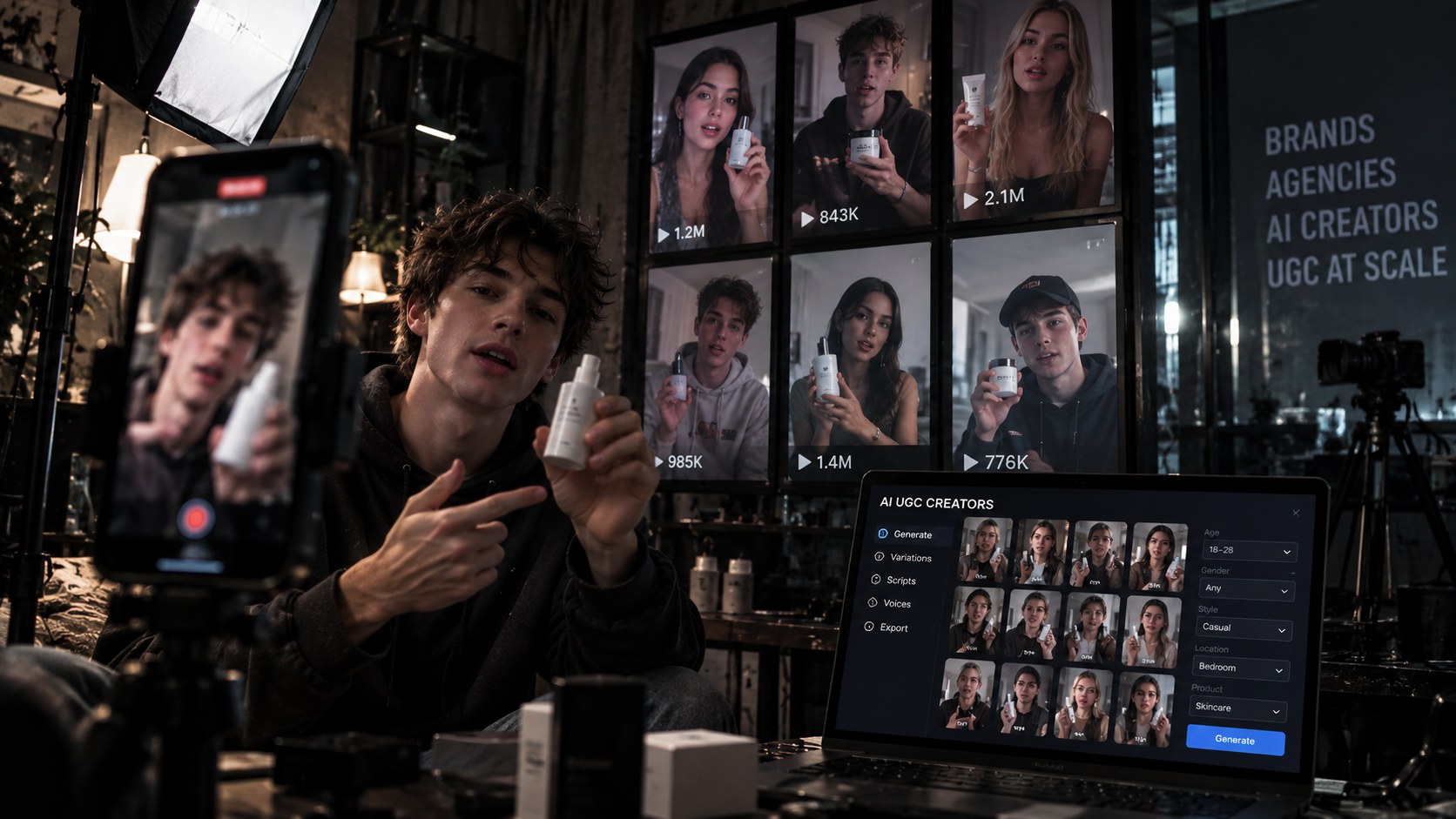
The short version
- AI UGC is creator-style advertising made partly or entirely with synthetic presenters, voices, footage or avatars; it is not evidence of a real customer's experience.
- Its clearest advantage is production leverage: brands can test scripts, hooks, languages and formats without scheduling a new shoot for every variation.
- Synthetic creators fit best when they deliver a brand-authored message. They become risky when the ad implies personal use, satisfaction or results that no real person experienced.
- Platform and legal rules increasingly treat AI identity, sponsorship and synthetic-media disclosure as separate transparency questions.
- Early research is mixed enough that brands should test synthetic creative as its own format rather than assume it preserves the trust of human UGC.
AI UGC is an ad-production format wearing creator clothes
A person looks into a phone camera and says a product fixed their problem.
The lighting is ordinary. The room is ordinary. The delivery is a little imperfect. It resembles the hundreds of creator videos around it in the feed.
Except the person does not exist.
That is the basic tension inside AI UGC. The format borrows the visual language of user-generated content — selfie framing, direct-to-camera speech, casual environments, quick demonstrations — while removing the user from the production process.
Sometimes that is completely reasonable. A synthetic presenter can read brand copy, introduce an app, explain a feature or deliver the same script in twelve languages without twelve shoots.
Sometimes it is not. If the synthetic presenter says “I’ve been using this for three months” or describes a personal result that nobody actually experienced, the advertiser has crossed from simulated production into invented testimony.
The useful way to judge AI UGC is therefore not human versus AI.
It is:
What job is the synthetic person being asked to do?
If the job is performance, AI can be useful. If the job is proof, experience or borrowed trust, a generated face cannot supply the missing reality.
“AI UGC” covers several different things
The term is already loose enough to create bad comparisons.
At least three workflows are routinely grouped together:
| Format | What is real? | What AI changes | What the advertiser is buying |
|---|---|---|---|
| AI-assisted creator content | A real person and usually real footage | Script help, editing, dubbing, cleanup, localization or generated inserts | Human presence plus faster production |
| Synthetic presenter ad | The product, offer and advertiser may be real; the presenter may not be | Face, voice, performance or environment | A controllable actor-like delivery system |
| Persistent virtual influencer | The character is synthetic but has an ongoing identity and audience | Persona, imagery, voice and sometimes interactions | A media character that can carry brand partnerships over time |
These are not interchangeable.
A real creator whose voice is translated with AI still brings their identity, audience and actual experience. A stock avatar reading a script does not. A virtual influencer with an established following occupies another category again: fictional, but potentially recognizable enough to function more like entertainment IP than anonymous ad talent.
Calling all three “AI creators” hides the part advertisers should care about most: where the credibility is supposed to come from.
The strongest use case is multiplication
AI changes the economics of producing variants much more clearly than it changes the psychology of persuasion.
A conventional creator shoot has friction. Someone must be sourced, briefed, scheduled and paid. Products may need to be shipped. Reshoots take time. A new language can require another performance.
Synthetic production can compress that cycle.
One approved concept can become:
- five opening hooks;
- three lengths;
- several calls to action;
- multiple languages;
- different crops for Reels, TikTok and Shorts;
- alternate presenters or environments;
- quick revisions when an offer changes.
That makes AI UGC particularly attractive in paid-media testing, where the goal is often to discover which message deserves more budget.
This is also where the format is easiest to defend editorially. The synthetic person is not being used because they possess special authority. They are being used because they can deliver a controlled message cheaply and repeatedly.
The comparison is less “AI influencer versus human influencer” and more synthetic production versus another video-production method.
That distinction matters. A brand can legitimately prefer an AI presenter because it needs fifty variations. It does not follow that the AI presenter has replaced what made a trusted human creator valuable.
A synthetic presenter can perform a claim. It cannot have the experience behind it.
The cleanest line comes from U.S. advertising guidance.
The Federal Trade Commission says there is no blanket prohibition on AI-generated stock avatars in marketing. In its guidance on the Consumer Reviews and Testimonials Rule, the agency explicitly addresses AI stock avatars and says their use is not automatically banned.
But the underlying testimonial still has to be real.
The FTC defines a testimonial around a message consumers are likely to understand as reflecting someone’s experience with a product or service. Its guidance says businesses can be liable when influencers misrepresent whether they used a product or what happened when they did. The agency also warns that using actors to portray testimonialists can still be deceptive depending on how the ad is presented.
The FTC’s current Q&A makes the distinction unusually clear: an AI avatar is not the problem by itself. Fabricated experience is.
That gives advertisers a practical test.
A synthetic presenter saying:
“The app automatically turns this recording into captions.”
is delivering a product claim that the advertiser can substantiate.
A synthetic presenter saying:
“I’ve used this every day for six months and doubled my sales.”
is presenting a personal history.
If no such person had that experience, the second line is not made truthful because the avatar looks convincing or because “AI generated” appears in small text.
Disclosure does not turn a false claim into a true one.
This is where AI UGC fits well
The format is strongest when the viewer does not need to believe in the presenter’s biography.
Scripted product explanation
A synthetic presenter can introduce software, explain a workflow, summarize an offer or move a viewer through a list of features.
The person is functioning like an actor or spokesperson. The factual burden stays on the product claims.
Creative testing
If a media buyer wants to test ten hooks before commissioning a bigger campaign, synthetic production can reduce the cost of learning.
The useful output is not “a fake customer.” It is a set of controlled creative experiments.
That also makes measurement cleaner. A team can hold the offer and visual structure steady while changing the first line, CTA or framing, then read the result alongside more conventional creator ads. Our guide to reading creator analytics applies the same discipline: decide what question the metric is answering before treating the number as a verdict.
Localization
Translation, synthetic voice, lip-sync and avatar systems can make one approved message portable across markets.
This is especially attractive when the alternative is rebuilding an essentially identical informational ad for every language.
The risk is assuming that linguistic translation equals cultural translation. A line that sounds natural in one market can still sound bizarre in another. A synthetic workflow removes production friction, not the need for local judgment.
Brand-owned characters
A deliberately fictional character can be useful when the fiction is part of the creative idea.
Mascots have always done this. Virtual influencers extend the concept into social media: recurring characters can have recognizable voices, aesthetics and story worlds without pretending to be ordinary customers.
A 2025 systematic review of 51 virtual-influencer studies found that authenticity, transparency, trust and cultural context repeatedly shaped audience responses. The research does not reduce virtual influencers to a simple human-versus-machine performance ranking.
That is a useful warning. A synthetic character can become a real media asset. It still has to earn whatever relationship the audience develops with it.
This is where it fits badly
The closer an ad gets to testimony, the weaker the case for replacing the human.
Personal product experience
Skincare, supplements, financial products, productivity systems, coaching and other categories often use “this worked for me” as the entire persuasive mechanism.
If the speaker is synthetic, there is no “me” with a lived result.
The brand can still dramatize or explain a product. It should not manufacture a satisfied customer.
Before-and-after proof
The same problem becomes sharper when the creative implies transformation.
A generated face, body, bank balance, room, analytics dashboard or business result can make an outcome look documented when nothing was documented.
That is not merely an AI issue. It is an evidence issue. The same logic applies to a manipulated screenshot: the frame can look precise while proving much less than the viewer assumes.
High-trust creator partnerships
A real creator can bring distribution, reputation, taste, audience history and the cost of attaching their own identity to a recommendation.
A synthetic presenter has none of those things by default.
This is why replacing a production creator and replacing an influencer are different decisions. The first may save a shoot. The second asks software to replace a relationship.
Sensitive claims
Health, finance and other high-stakes categories leave less room for ambiguity about who is speaking, what happened and what evidence supports the claim.
Even when a synthetic presenter is permitted, the creative burden is higher. A realistic avatar can make a scripted statement feel like lived experience faster than a graphic card or ordinary voiceover would.
That can be a feature for attention and a liability for trust.
Disclosure is becoming part of the format, not an optional footnote
There are now several disclosure layers operating at once.
Commercial disclosure answers: is this an advertisement or paid relationship?
Synthetic-media disclosure answers: was this person, voice or scene generated or materially altered?
Claim substantiation answers: is what the ad says actually supported?
They are related, but one does not substitute for another.
The FTC’s 2023 revision to its Endorsement Guides explicitly clarified that endorsements can include virtual influencers, while continuing to require material connections to be disclosed clearly and conspicuously. The advertiser does not escape endorsement rules because the endorser is synthetic.
Platforms are adding their own AI labels on top.
TikTok says AI-generated, synthetic or manipulated media is a mandatory disclaimer use case in Ads Manager. Meta says its advertising systems label ads created or significantly edited with its generative tools and, in a June 2026 update, began expanding its “AI info” approach toward detectable signals from third-party tools as well. Meta is moving that information into its broader “About this ad” surface.
Google added AI-label settings across several ad products in July 2026 and explicitly tied the change to emerging transparency rules in multiple jurisdictions. Google also warns that using its label setting does not itself guarantee legal compliance.
In the European Union, Article 50 AI Act transparency obligations began applying on 2 August 2026. The rules include machine-readable marking obligations for providers of generative systems and disclosure duties for deployers in specified cases, including qualifying deepfakes. The European Commission’s guidance is explicit that the exact obligation depends on what was generated, how it is deployed and whether it could falsely appear authentic.
None of this means every use of AI in an ad receives the same label everywhere.
It means the old workflow — generate first, ask whether disclosure matters after launch — is becoming indefensible.
The uncomfortable part: disclosure can change performance
Transparency is good policy. That does not mean audiences are indifferent to it.
A newly published 2026 study in Computers in Human Behavior tested AI-generated Instagram advertising in a travel context. In the influencer condition, disclosing AI generation improved recognition that the content was AI-generated, but it also reduced brand credibility, attitudes and purchase intention in that experiment. The effect was shaped partly by participants’ existing attitudes toward AI.
Other virtual-influencer studies produce different patterns depending on realism, sponsorship, message type and audience. The literature is still young enough that “AI creators perform better” and “people hate AI creators” are both far too confident.
Industry research tells a similarly awkward story.
In a 2026 IAB/Sonata Insights survey, 82% of advertising executives thought Gen Z and Millennial consumers felt positively about AI-generated ads, while 45% of those consumers reported feeling positively. Yet 73% said knowing an ad used AI would either increase or make no difference to their likelihood of purchasing. More than half wanted disclosure for fully AI-generated ads, AI video or AI imagery.
That is not a universal effectiveness study. It is a survey.
But it punctures two convenient assumptions at once: advertisers may be more enthusiastic about AI creative than audiences are, and disclosure is not necessarily commercial suicide.
The sensible response is to test the format honestly.
Human UGC and AI UGC should not be measured as if they sell the same thing
A creator campaign can buy several assets at once:
- production;
- a recognizable person;
- distribution;
- audience trust;
- cultural taste;
- actual product experience;
- permission to reuse the resulting footage.
AI UGC usually buys fewer things:
- production;
- variation;
- speed;
- control;
- localization;
- a human-shaped delivery surface.
That can still be extremely valuable.
It simply changes the benchmark.
If a brand pays a real creator mainly to obtain thirty seconds of usable footage for paid social, a synthetic workflow can compete directly with part of that production budget.
If a brand pays the creator because 200,000 people care what that specific person thinks, the synthetic alternative is missing the asset that mattered.
The error is treating “person on screen” as a commodity while ignoring why that person was persuasive.
The best near-term model is probably hybrid
The strongest use of generative production may be to multiply real creative rather than erase the real creator.
A human can supply the original performance, product experience and identity. AI can help generate alternate edits, translated versions, hooks, backgrounds, voice tracks or controlled derivatives where consent and rights allow.
Synthetic presenters can cover informational ads and rapid concept tests. Real customers can handle actual testimonials. Established creators can be reserved for campaigns where their audience and reputation are the point.
That is less dramatic than “AI replaces UGC creators.”
It is also a much more useful operating model.
The production stack gets cheaper and more flexible while the advertiser stops asking generated people to pretend they possess experiences that only humans can have.
The line is not whether the person is real. It is whether the claim is.
Advertising has always contained actors, animation, voiceovers, retouching, fictional characters and sets.
Synthetic creators belong in that lineage.
What is new is how cheaply software can now imitate the exact visual cues that make a video feel like an ordinary person spontaneously recommending something. The camera shake, bedroom, face, voice and casual delivery can all be manufactured together.
That makes the disclosure question important.
It makes the evidence question more important.
A synthetic creator can be an efficient spokesperson, a repeatable character, a localization layer or a creative-testing machine. It can even become an audience property in its own right.
What it cannot do is retroactively create a customer who used the product, a creator who formed an opinion, or a result that happened in the real world.
The clean version of AI UGC keeps that boundary visible.
The synthetic person performs the ad.
Reality still has to support the claim.
Sources & reference material
- The Consumer Reviews and Testimonials Rule: Questions and AnswersFederal Trade Commission · Accessed Oct 09, 2026
Explains that the FTC rule does not impose a blanket ban on AI stock avatars, but false or fake underlying testimonials remain prohibited and avatar use can still be deceptive under the FTC Act.
- Federal Trade Commission Announces Updated Advertising Guides to Combat Deceptive Reviews and EndorsementsFederal Trade Commission · Accessed Oct 09, 2026
The 2023 Endorsement Guides update clarified that endorsements can include virtual influencers and strengthened guidance on clear and conspicuous disclosures.
- About ad disclaimers in TikTok Ads ManagerTikTok for Business · Accessed Oct 09, 2026
TikTok describes AI-generated, synthetic or manipulated media as a mandatory disclaimer use case in Ads Manager.
- Expanding GenAI Transparency for Meta’s Ads ProductsMeta · Accessed Oct 09, 2026
Meta describes AI-info labeling for ads created or significantly edited with its tools and a 2026 expansion toward detection of third-party AI signals.
- Updates to AI labeling requirements (July 2026)Google Ads · Accessed Oct 09, 2026
Google added AI-label settings across advertising products and permits in-creative AI labels to support compliance with emerging transparency requirements.
- Guidelines on transparency obligations for providers and deployers of certain AI systemsEuropean Commission · Accessed Oct 09, 2026
Explains Article 50 AI Act transparency obligations applying from 2 August 2026, including machine-readable marking requirements and disclosure duties for qualifying deepfakes.
- The AI Ad Gap WidensInteractive Advertising Bureau · Accessed Oct 09, 2026
Reports IAB and Sonata Insights survey results showing a gap between advertiser expectations and Gen Z/Millennial sentiment toward AI-generated ads, alongside consumer support for disclosure.
- Authenticity, ethics, and transparency in virtual influencer marketing: A cross-cultural analysis of consumer trust and engagement: A systematic literature reviewActa Psychologica / PubMed · Accessed Oct 09, 2026
Systematic review of 51 studies identifying authenticity, transparency, trust and cultural context as recurring factors in responses to virtual influencers.
- Is this real or Fake? Examining the effects of disclosure of AI-generated content and source type in instagram-based travel destination advertising on consumer attitudes and behavioral intentionsComputers in Human Behavior · Accessed Oct 09, 2026
Two experiments found that AI-origin disclosure improved recognition of AI-generated advertising and, in the influencer condition studied, reduced brand credibility, attitude and purchase intention.