
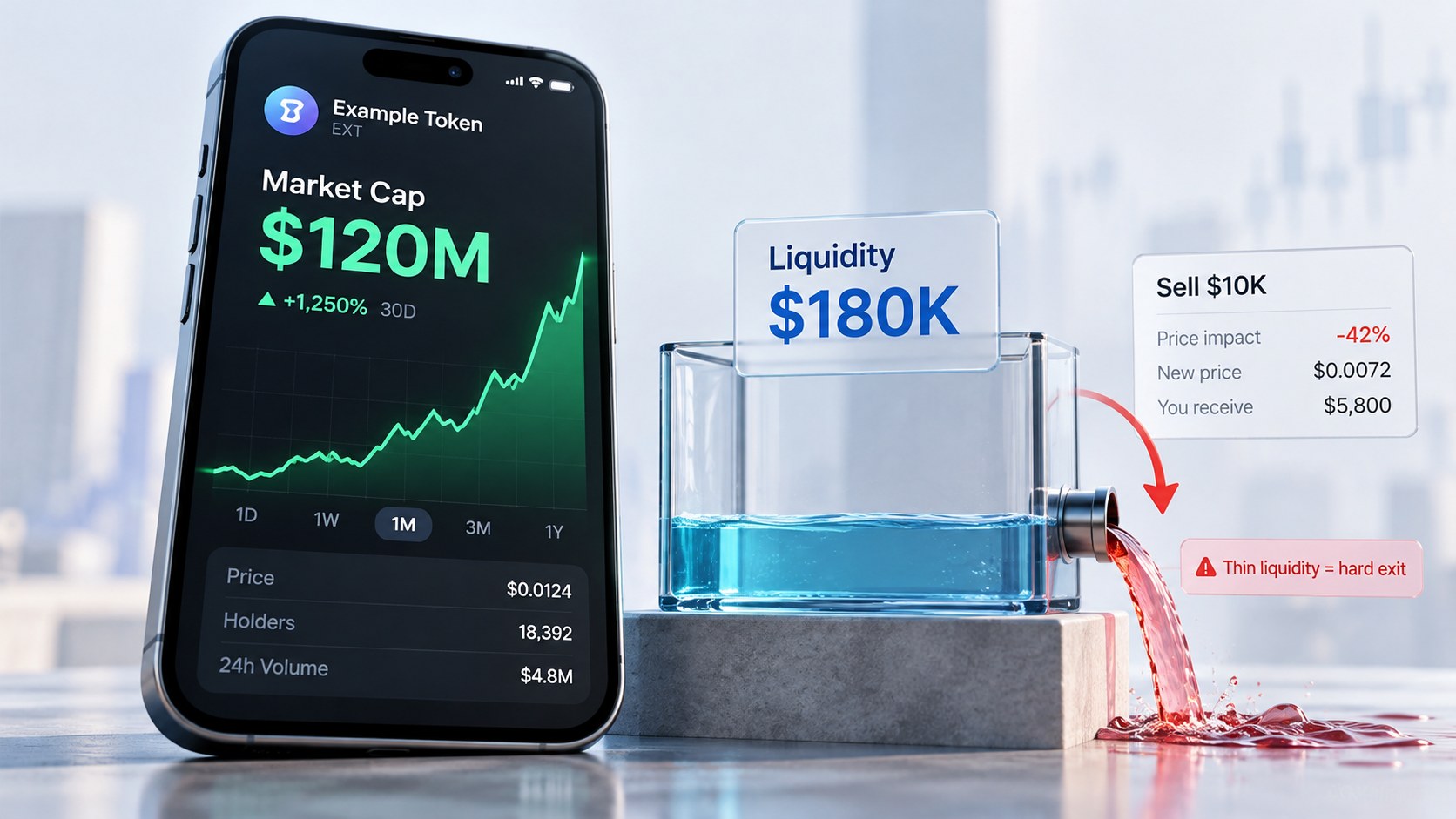
The short version
- Market cap is a derived valuation: current price multiplied by circulating supply. It is not the amount of cash invested in a token or the amount available to sellers.
- Liquidity describes how much trading the market can absorb without the price moving sharply. A token can therefore have a large market cap and shallow liquidity at the same time.
- A wallet balance shown at the current spot price is also a mark-to-market estimate. A large holder may receive far less if selling the position moves through a thin pool or order book.
- On decentralized exchanges, pool depth and price impact matter; on centralized exchanges, order-book depth and spread matter. Twenty-four-hour volume is useful context but is not the same thing as liquidity available right now.
- When reading a crypto screenshot, check market cap, liquidity, volume, supply definition, holder concentration and the size of the position being shown before treating the displayed dollar value as realizable money.
A $10 million market cap does not mean there is $10 million to sell into
A crypto screenshot can be numerically accurate and still create the wrong impression.
Imagine a token dashboard showing:
- market cap: $10 million;
- your position: $50,000;
- price: $0.01.
Nothing on the screen has to be fake.
The mistake is reading those numbers as if they say $10 million of money sits behind the token or the $50,000 position can be converted into $50,000 without changing the price.
Neither follows from market cap.
CoinGecko defines crypto market capitalization as circulating supply multiplied by the current token price. CoinMarketCap uses the same core relationship for its circulating market cap: reference price × circulating supply.
That makes market cap useful as a valuation shorthand. It does not make it a cash balance.
Market cap is multiplication
Suppose a token has:
- 1 billion tokens in circulating supply;
- a current price of $0.01.
Its market cap is:
1,000,000,000 × $0.01 = $10,000,000
The calculation says that if every circulating token is marked at the current price, the circulating supply has a notional value of $10 million.
It does not say:
- buyers have deposited $10 million into the token;
- $10 million sits in a liquidity pool;
- every holder can sell at $0.01;
- a $1 million position can exit for $1 million;
- the market could absorb the entire circulating supply at the quoted price.
CoinGecko explicitly warns that market cap is not the same as cash inflow or total invested capital. The quoted price is being extrapolated across the supply.
That distinction barely matters when you are only comparing headline size. It matters enormously when a screenshot is being used to imply spendable wealth.
Liquidity asks a different question
Liquidity is about execution.
How much can someone buy or sell before the market moves materially against them?
Uniswap describes price impact as the change in token price caused by the trade itself. Deeper liquidity generally means less price impact; thinner liquidity means more.
That is why market cap and liquidity can sit wildly far apart.
CoinMarketCap now publishes an on-chain Liquidity-to-Market-Cap ratio for this reason. Its metric compares total DEX liquidity with circulating market cap, and its own example contrasts a $1 billion token with $1 million of on-chain liquidity against a $1 million token with the same $1 million of liquidity. The headline valuations are radically different; the on-chain depth is not.
A market cap screenshot tells you what the circulating supply is being valued at around the current price.
Liquidity tells you how fragile that price may be when somebody actually trades.
One simplified pool shows the gap
Take the same hypothetical token:
- circulating supply: 1 billion tokens;
- starting price: $0.01;
- displayed market cap: $10 million.
Now assume its main market is a simple 50/50 constant-product pool containing:
- 10 million tokens;
- $100,000 of a dollar stablecoin.
At the starting price, the token side is also worth about $100,000, so the two sides of the pool have a combined spot value of roughly $200,000.
A holder owns 5 million tokens. Their wallet or portfolio tracker marks the position at:
5,000,000 × $0.01 = $50,000
The screenshot says $50,000.
But the pool does not promise to buy 5 million tokens at one cent each.
In the simplified constant-product model documented by Uniswap, the reserves maintain the relationship x × y = k. As tokens are sold into the pool, the token reserve rises, the stablecoin reserve falls and the marginal price moves against the seller.
Ignoring swap fees, routing and outside arbitrage for the moment, selling all 5 million tokens into this isolated pool would return about $33,333, not $50,000.
| What the screen suggests | What the simplified sale produces |
|---|---|
| Starting token price | $0.0100 |
| Displayed market cap | $10,000,000 |
| Wallet tokens | 5,000,000 |
| Wallet value at spot | $50,000 |
| Stablecoin received from sale | ~$33,333 |
| Average execution price | ~$0.00667 |
| Pool price after the sale | ~$0.00444 |
The exact result in a real trade depends on pool design, fees, concentrated liquidity, routing, arbitrage and liquidity on other venues. The example is deliberately simple.
The principle is not.
A balance calculated at the current marginal price is not the same thing as the proceeds from liquidating the balance.
Small trades can create large changes in notional market cap
The same mechanics work in reverse.
If a relatively small buy moves a thin market from $0.005 to $0.01, a dashboard can show the market cap doubling because the new quoted price is now being multiplied across the entire circulating supply.
That does not mean an amount of cash equal to the increase in market cap entered the token.
With 1 billion circulating tokens:
- $0.005 implies a $5 million market cap;
- $0.010 implies a $10 million market cap.
The displayed valuation increased by $5 million.
The trade that moved the marginal price did not need to contain $5 million.
This is one of the most important things to understand when looking at small-cap crypto charts. Market cap can move by millions because the price used in the multiplication moved, not because millions of dollars moved into or out of the asset.
CoinGecko makes the same point in its market-cap guidance: price appreciation can increase market cap without an equivalent amount of net cash inflow, and low-liquidity assets are particularly sensitive to price manipulation and sharp moves.
Wallet screenshots inherit the same problem
Portfolio apps usually need a simple way to turn tokens into dollars. The obvious method is mark-to-market arithmetic:
tokens held × current reference price = displayed position value
That is useful. It is also conditional.
A wallet showing $250,000 worth of an actively traded large-cap asset is not economically equivalent to a wallet showing $250,000 worth of a thin token whose largest pool cannot absorb a meaningful fraction of that position near the quoted price.
Both screens can display the same dollar amount.
One may be much easier to realize.
This is why a genuine screenshot should be read as evidence of what the interface displayed, not automatically as proof of what the holder could withdraw. SIGNULL’s broader guide to screenshot context makes the same distinction: the image can be authentic while the conclusion drawn from it is too large.
“Liquidity” is not one universal number either
Crypto trades through different market structures, so the useful liquidity question changes with the venue.
On a decentralized exchange
For an automated market maker, inspect the pools actually available to the token, the depth of those pools and the price impact of the trade size you care about.
A displayed pool value is not a guarantee that the entire amount is available to one seller at the current price. The reserves change as the swap executes.
If the token exists across several DEX pools or chains, liquidity may be fragmented. Aggregating those pools can give a broader view, which is why CoinMarketCap’s on-chain liquidity metric sums relevant DEX liquidity rather than looking only at one pool.
On a centralized exchange
There may be no public AMM pool to inspect. Liquidity lives in the order book: bids, asks, spread and depth at different prices.
CoinMarketCap’s current Liquidity Score methodology evaluates market pairs partly by simulating orders across different sizes and measuring the resulting slippage. That is closer to the trader’s actual question than simply asking how much volume traded yesterday.
A screenshot that says $8 million 24h volume does not tell you how much buy-side depth is available right now within 1% of the current price.
Volume is activity over a period. Liquidity is the market’s ability to absorb a trade at acceptable execution.
Even the “price” in a screenshot needs context
A token can trade on multiple markets at slightly different prices.
Large market-data sites therefore do not necessarily treat one last trade as universal truth. CoinMarketCap says its reference prices are derived from integrated exchange data and subjected to data-cleaning and outlier controls. Its methodology explicitly rejects the idea that an unsupported price feed should automatically determine market cap.
A DEX terminal, meanwhile, may be showing the price from the specific pool or pair on screen.
That means two authentic screenshots taken at the same moment can show somewhat different prices, market caps or liquidity figures because they are measuring different markets or using different supply and price methodologies.
The right question is not only is the screenshot real?
It is what exactly is this number measuring?
Market cap, FDV, liquidity and volume are not interchangeable
| Metric | What it is trying to tell you | What it does not tell you by itself |
|---|---|---|
| Market cap | Current price × circulating supply | Cash invested, exit value or market depth |
| FDV | Current price × a broader total/max-supply measure | What future tokens will actually trade for |
| Liquidity | How much trading a market can absorb with limited price movement | Project quality or future demand |
| 24h volume | Value traded over a defined period | Current order-book or pool depth |
| Wallet value at spot | Holdings marked at the current reference price | Guaranteed liquidation proceeds |
The supply line deserves attention too.
CoinMarketCap’s September 2026 methodology distinguishes circulating market cap from unlocked, minted and fully diluted valuations because the word market cap is not used consistently across every crypto interface. Its circulating-supply process attempts to separate public float from insider, treasury and locked allocations.
If one dashboard is showing circulating market cap and another is effectively showing FDV, the screenshots may differ dramatically without either price being wrong.
How to read a crypto screenshot without getting fooled by the headline number
When a screenshot is meant to prove that a token, trade or wallet is worth a large amount, read the numbers in this order:
- What price is being used? Is it a global reference price, one exchange, or one DEX pair?
- Which supply number produced the valuation? Circulating supply, total supply and max supply can imply very different figures.
- How much liquidity is actually available? Look at the relevant pools or order-book depth, not only market cap.
- How large is the shown position relative to that liquidity? A $5,000 position and a $500,000 position do not face the same exit problem.
- What does a simulated sell quote return? On a DEX, a quote for the actual trade size exposes price impact far better than the headline token price.
- What is the volume, and where did it happen? High activity is useful context, but it does not replace current depth.
- How concentrated is ownership? A few large holders can represent potential sell pressure that market cap alone does not reveal.
None of those checks proves that a token is good, bad, legitimate or fraudulent. They answer a narrower question:
Does the market behind the screenshot support the financial impression the screenshot creates?
The screenshot can be real while the wealth is not realizable at that price
Market cap is not a useless metric. It is one of the cleanest ways to compare the notional size of crypto assets when the price and supply inputs are credible.
The mistake is asking it to answer a liquidity question.
A $10 million market cap does not mean $10 million was invested. A $100,000 wallet balance does not mean a holder can necessarily sell for $100,000. A token can have a large displayed valuation and a market too shallow to support the implied exit.
That is why crypto screenshots are especially persuasive as status objects: they compress price, position size and valuation into one clean frame while hiding the market mechanics outside the crop. The same mechanism appears in the broader internet habit of using visible wealth signals as shorthand for actual wealth.
Read market cap as valuation.
Read liquidity as tradability.
And do not confuse a number calculated at the current price with money already sitting on the other side of the trade.
Sources & reference material
- What Is Market Cap in Crypto and How Is It Calculated?CoinGecko · Accessed Oct 09, 2026
Market capitalization equals circulating supply multiplied by current token price; market cap is not the same as invested capital and does not directly measure liquidity.
- Market Capitalization (Cryptoasset, Aggregate)CoinMarketCap · Accessed Oct 09, 2026
CoinMarketCap calculates circulating market capitalization from its reference price multiplied by current circulating supply and distinguishes it from other valuation measures such as FDV.
- Supply (Circulating, Total, Max)CoinMarketCap · Accessed Oct 09, 2026
Current CoinMarketCap methodology distinguishes circulating market cap, unlocked market cap, minted market cap and fully diluted valuation, and documents its circulating-supply verification process.
- On-chain Liquidity to Market Cap Ratio Now Live on CoinMarketCap – Why It MattersCoinMarketCap · Accessed Oct 09, 2026
CoinMarketCap's on-chain Liquidity-to-Market-Cap metric compares total DEX liquidity with circulating market cap and is intended to add slippage and market-depth context to headline valuation.
- What is price impact?Uniswap Labs · Accessed Oct 09, 2026
Price impact is the price change caused by a trade; larger pools generally produce less price impact while low-liquidity pools produce more.
- How are token prices determined?Uniswap Labs · Accessed Oct 09, 2026
Uniswap documents the constant-product x*y=k relationship used to explain how pool balances and prices change during swaps.
- Liquidity Score (Market Pair, Exchange)CoinMarketCap · Accessed Oct 09, 2026
For order-book markets, CoinMarketCap evaluates liquidity using order-book depth and simulated slippage across a range of trade sizes.
- Price (Market Pair, Cryptoasset)CoinMarketCap · Accessed Oct 09, 2026
CoinMarketCap derives cryptoasset reference prices from integrated exchange data and applies data-cleaning and outlier controls rather than treating every venue quote as equally representative.