
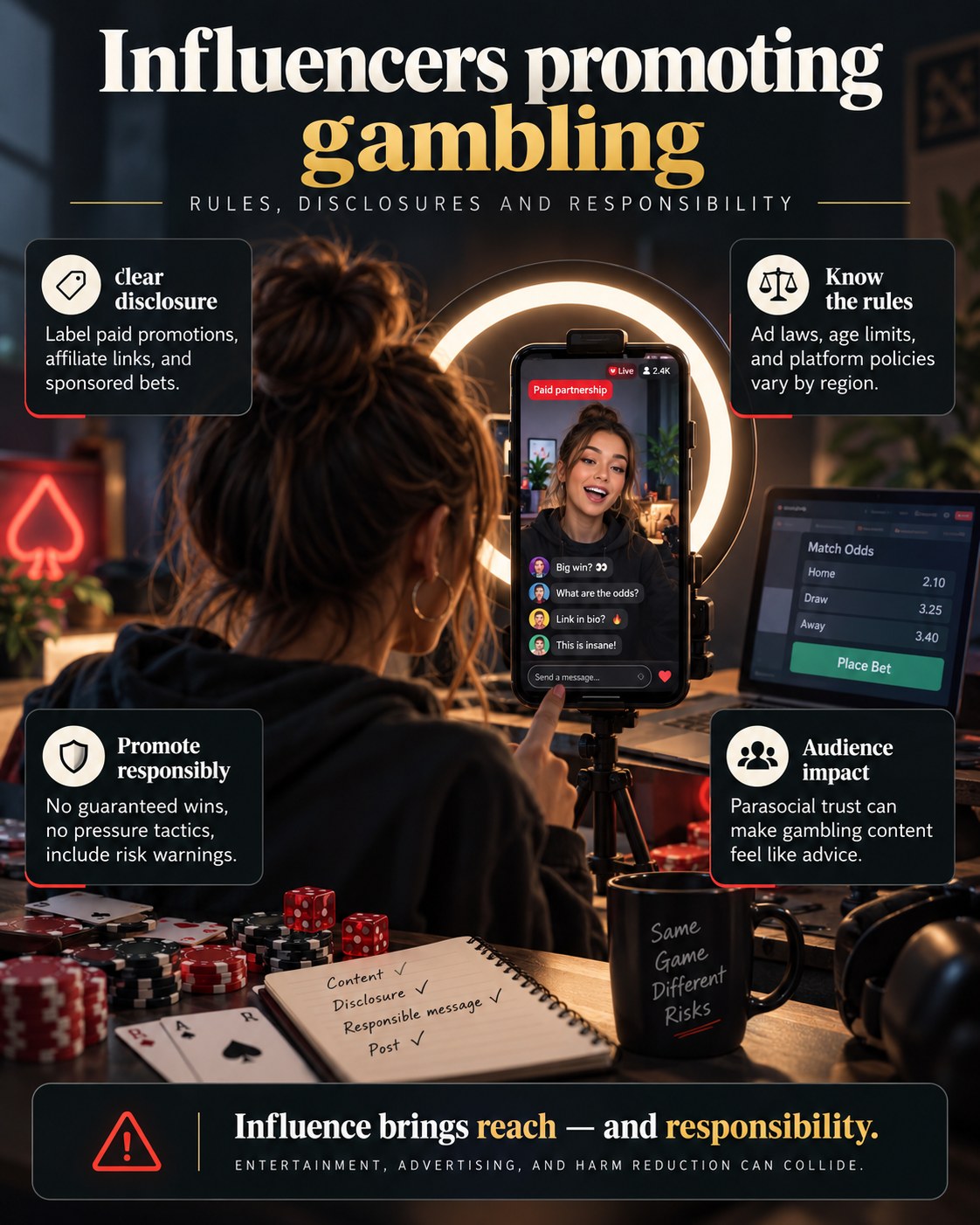
The short version
- A clear #ad or sponsored disclosure is necessary when a creator has a material connection to a gambling brand, but disclosure does not make an otherwise prohibited gambling promotion legal.
- Affiliate links, referral codes, revenue share, free benefits and other commercial relationships can turn apparently casual gambling content into advertising that needs disclosure and may trigger gambling-specific rules.
- Youth protections are often stricter than ordinary influencer marketing: Ontario restricts influencers likely to appeal to minors and generally bans athlete endorsements for igaming, while Great Britain bars gambling ads with strong appeal to under-18s and heavily restricts under-25s in ads.
- The content matters as much as the label. Gambling ads can breach rules by presenting betting as income, financial security, an escape from problems, a guaranteed win or a reason to chase losses.
- Creators and operators need to check the law, regulator rules and platform policy for the audience actually receiving the post. A compliant sponsorship in one market or on one platform can be prohibited in another.
An influencer can put #ad in the first line, tag the sportsbook, turn on a paid-partnership label and still publish a gambling promotion that should never have gone live.
That is the part most disclosure advice misses.
Gambling sponsorships sit under several rule sets at once. Ordinary influencer advertising rules ask whether the commercial relationship is clear. Gambling rules ask whether the operator, product, audience, creator and message are permitted. Platform rules can then be stricter than either.
Passing one test does not pass the others.
A gambling post has more than one compliance gate
A useful way to read a gambling promotion is to separate the questions.
| Gate | The question |
|---|---|
| Commercial relationship | Is the creator being paid, rewarded or otherwise connected to the brand? |
| Disclosure | Can a viewer immediately tell the content is advertising? |
| Gambling permission | Is this operator and product legal to market to this audience in this place? |
| Audience | Are minors, self-excluded users or other protected groups being reached or targeted? |
| Creator | Is this influencer, athlete, celebrity or on-screen person allowed to appear? |
| Message | Does the content misrepresent winning, risk, financial outcomes or the terms of an offer? |
| Platform | Does the social network allow this kind of gambling promotion at all? |
This is why “I disclosed the sponsorship” is not a complete defence.
The disclosure can be perfect while the promoted casino is unlicensed, the influencer is prohibited, the audience is too young, the bonus terms are misleading or the platform bans the format.
The disclosure is the easiest part
In Canada, the Competition Bureau says the Competition Act applies to influencers. A material connection can include money, commissions, discounts, free products or services, trips, tickets or personal and family relationships.
The basic rule is simple: make the connection obvious where the endorsement appears.
A brand tag is not necessarily enough. Neither is a discount code, an affiliate link in the bio or a vague phrase such as “partner.” The Bureau recommends clear, prominent disclosure that people can see without expanding a post, and notes that some formats may require both audio and visual disclosure.
The US Federal Trade Commission takes the same general approach. Its Endorsement Guides guidance treats a relationship that could affect the weight or credibility of an endorsement as material. Its practical influencer guide says disclosures should be hard to miss, placed with the endorsement, included in the video rather than only its description, and repeated periodically during livestreams.
For a static post, Ad, #ad or Sponsored placed upfront is much harder to misunderstand than a pile of hashtags at the bottom.
For a video or stream, the useful standard is tougher: someone who only watches the content itself should still understand that money or another commercial benefit is behind it.
Affiliate links are advertising relationships too
Gambling creators often sit somewhere between influencer and affiliate.
A creator might receive:
- a flat sponsorship fee;
- a payment for each new depositor;
- a percentage of revenue generated by referred players;
- some other performance-based commission or benefit.
The format changes the incentive. It does not make the relationship disappear.
If a creator earns money when viewers sign up or gamble, that fact can matter to how a viewer evaluates the recommendation. In Canada, commissions are explicitly listed by the Competition Bureau as a material connection that should be disclosed.
The United Kingdom goes further on the operator side. The Gambling Commission says licensed businesses remain responsible for third parties they contract with. An operator cannot simply hand acquisition to an affiliate network and treat whatever appears on social media as somebody else’s compliance problem.
That matters because affiliate economics can quietly change the tone of content. A creator paid per acquisition has a direct financial reason to make signing up feel urgent, easy and attractive. A creator paid on revenue share can have an even longer-term interest in referred users continuing to gamble.
The disclosure does not remove that incentive. It lets the audience see that the incentive exists.
Gambling rules can restrict the influencer, not just the wording
Ontario is one of the clearest examples.
Since February 28, 2024, the Alcohol and Gaming Commission of Ontario’s internet-gaming advertising standard has prohibited the use of active or retired athletes who have an arrangement with an operator or gaming-related supplier, except when the advertising is exclusively about responsible gambling. The same standard bars social media influencers, celebrities, entertainers, role models and similar figures who would likely be expected to appeal to minors. The AGCO announced those changes in 2023.
The important distinction is that an influencer is not automatically banned in Ontario. The test is whether that person would likely be expected to appeal to minors. Athletes are treated more strictly.
Canada also gained another layer in 2026. The Canadian Gaming Association’s Code for Responsible Gaming Advertising took effect in January 2026. It is not a national gambling-advertising law: Ad Standards describes it as a voluntary code for CGA members and other signatories that supplements federal and provincial requirements.
For those advertisers, however, the influencer rules are unusually concrete. The code says:
- gaming ads should not use active or retired athletes except for responsible-gambling advocacy;
- models, actors and influencers used in gaming advertising should be at least 25;
- influencers, celebrities and role models likely to appeal to people below the legal gambling age should not advertise gaming products;
- social and digital ads should use age-targeting tools to keep them from people under 21;
- influencers should clearly disclose the material connection with language such as #ad or #sponsored and identify the brand.
That is a good example of why there is no single “Canadian influencer gambling rule.” A campaign can sit under federal truth-in-advertising law, provincial gambling regulation and a separate industry code at the same time.
Great Britain adds a strong-appeal test
Great Britain’s CAP Code gambling rules are another useful stress test for creator campaigns.
Gambling ads must not be likely to have strong appeal to people under 18, especially through youth culture. They also must not include a person or character whose example is likely to be followed by under-18s or who has strong appeal to them.
That is stricter than asking whether an ad was deliberately aimed at children.
A creator can have an overwhelmingly adult audience and still be a problem if their wider public profile gives them strong appeal to under-18s. Prominent footballers and other sports figures have repeatedly triggered this rule.
There is also a separate age rule: in most gambling advertising, no one who is or seems to be under 25 may be shown gambling or playing a significant role. There is a narrow exception for certain transactional environments where a person aged 18–24 is the subject of the specific bet being offered. Ordinary social-media creator ads generally do not fit neatly inside that exception.
The regulator’s concern is not theoretical. In the Gambling Commission’s Young People and Gambling 2025 survey, 16% of young people surveyed said they followed gambling-related content on social or streaming platforms. Among that group, 31% said influencers, creators or streamers they followed had advertised gambling-related content to them.
Influencer marketing works partly because the advertisement arrives inside a relationship the audience already chose. That is exactly why youth appeal matters more here than it does in a generic banner campaign.
What the creator says can be the violation
A gambling ad does not become responsible because it ends with “18+” or “gamble responsibly.”
The underlying message still matters.
Great Britain’s CAP rules prohibit gambling advertising that suggests betting can solve financial concerns, act as an alternative to employment, provide financial security or help someone escape personal problems. Ads also cannot encourage socially irresponsible gambling or imply that gambling enhances status, recognition or personal qualities.
Ontario’s standards similarly prohibit claims that gambling is an investment, an alternative to employment, a path to financial security or a way to recover losses. They also prohibit false promises and presenting winning as the probable outcome.
The Canadian Gaming Association’s 2026 code adds its own restrictions for signatories. It bars ads that misrepresent the likelihood of winning, portray gambling as risk-free, associate gambling with financial or social status, or create false urgency around placing a bet.
This is where creator-native formats can go wrong quickly.
A conventional sportsbook banner saying “bet here” looks like advertising. A creator showing a winning slip while saying “this paid my rent,” “easy money,” “you can’t lose with this strategy” or “get in before the line moves” can turn the creator’s personality and apparent success into the claim.
That overlaps with a wider problem SIGNULL has covered before: online status signals can be much cheaper to manufacture than the success they imply. A betting win screenshot may be genuine and still omit deposits, losses, affiliate compensation or the losing bets around it. As with any financial-looking screenshot, the crop is only the beginning of the evidence.
Platform policy can veto a campaign that local law allows
Creators also have to satisfy the platform.
TikTok is a good example because its organic-content rule and advertising rule are deliberately different.
Its Community Guidelines say users may not facilitate or market gambling or gambling-like activities, including by linking people to a gambling service. Content that merely shows or glamorizes gambling can be restricted to adults and made ineligible for the For You feed.
Paid gambling advertising is a limited exception. TikTok’s current gambling advertising policy requires certification, restricts ads to approved markets and legal audiences, and imposes market-specific conditions. In Canada, for example, permitted online-casino and sports-betting advertising requires TikTok approval; the policy also lists aggregate or affiliate sites promoting gambling-related content among examples that are not allowed in the Canadian online-gambling section.
So “the sportsbook says this campaign is legal” is not enough.
The platform can still reject the ad, limit the post, remove the link or make the format unavailable.
The operator can be responsible. So can the creator.
Influencer contracts sometimes create the impression that compliance is a box one party can hand to the other.
Regulators do not necessarily see it that way.
The UK’s ASA guidance on influencer marketing says both brands and influencers are responsible for ensuring ads are obviously identifiable. The Gambling Commission separately makes licensed operators responsible for relevant third parties acting on their behalf.
In Canada, the Competition Bureau’s guidance is addressed directly to influencers as well as advertisers. The creator is not invisible simply because a betting company approved the script.
Australia offers an even more direct example. In 2025, the Australian Communications and Media Authority warned social-media influencers that promoting illegal online gambling services to Australians can expose individual creators to civil penalties. The warning specifically includes livestreaming play, promotional links and giveaways tied to illegal services.
The practical point is broader than Australia: verify the operator before lending it your audience.
A creator should know which legal entity is paying them, which licence or authorization covers the promoted product, and where that operator may legally accept the viewers being targeted. A logo and affiliate dashboard are not substitutes for that check.
A practical pre-post test
Before a gambling sponsorship goes live, the creator and operator should be able to answer seven questions without guessing.
-
Is the operator legal for the audience being targeted?
Check the actual operator and product, not just the brand name. -
Is this creator allowed to promote it?
Age, athlete status, celebrity status and youth appeal can matter. -
Is the audience allowed to receive the ad?
Geography, age targeting, self-exclusion and other protected groups can change the answer. -
Is the commercial relationship obvious?
Put the disclosure with the endorsement. For video and livestreams, make it visible inside the content rather than relying on the caption or bio. -
Are the claims supportable?
Do not turn a win into a promise, gambling into income, or a bonus headline into a misleading description of the offer. -
Are material offer terms visible where required?
A promotion is not accurately described if the conditions that materially change it are hidden behind the headline. -
Does the platform allow this exact format?
Check the current policy for gambling, branded content, affiliate links and paid ads in the target market.
If any answer is unclear, that is the point to stop the post — not the point to add another disclaimer.
Responsibility is bigger than a hashtag
There is a reason gambling sponsorship deserves more scrutiny than an ordinary clothing or software ad.
The creator is lending an operator something the gambling brand cannot manufacture on its own: the audience’s existing familiarity with a person.
That relationship can make an ad feel like a tip, a story, a win recap, a stream or a recommendation from someone worth listening to. Clear disclosure helps restore some of the missing context. It tells viewers that the enthusiasm may be connected to money.
But it does not tell them the operator is legal. It does not prove the audience is appropriately targeted. It does not make a prohibited influencer permissible. It does not turn a misleading win claim into a fair one. And it does not override the platform’s rules.
#ad tells the audience that a commercial relationship exists. Responsible gambling promotion begins with everything that still has to be true after that.
Sources & reference material
- Influencer marketing and the Competition ActCompetition Bureau Canada · Accessed Oct 10, 2026
Canadian guidance that influencers must disclose material connections such as payments, commissions, discounts, free products or services and other relationships, with disclosures made prominently and in context.
- Code for Responsible Gaming AdvertisingCanadian Gaming Association / Ad Standards · Accessed Oct 10, 2026
Current voluntary Canadian industry code, effective January 2026, including rules on adult audiences, athlete use, influencer age and appeal, social-media age targeting, material-connection disclosure and responsible gambling claims.
- About the Code for Responsible Gaming AdvertisingAd Standards · Accessed Oct 10, 2026
Confirms that the CGA Code applies to CGA members and other signatories and is a voluntary commitment that supplements rather than replaces federal or provincial law.
- AGCO to ban athletes in Ontario’s igaming advertising to protect minorsAlcohol and Gaming Commission of Ontario via GlobeNewswire · Accessed Oct 10, 2026
Ontario Standard 2.03 changes prohibiting active or retired athletes in igaming advertising except for responsible-gambling advocacy and restricting influencers, celebrities and other figures likely to appeal to minors, effective February 28, 2024.
- 16 GamblingAdvertising Standards Authority / Committee of Advertising Practice · Accessed Oct 10, 2026
Current Great Britain non-broadcast gambling advertising rules on social responsibility, strong appeal to under-18s, media targeting, financial claims and the use of people who are or seem to be under 25.
- Recognising ads: Social media and influencer marketingAdvertising Standards Authority / Committee of Advertising Practice · Accessed Oct 10, 2026
Current UK guidance that influencer advertising should be obviously identifiable, with a prominent upfront ad label, and that both brands and influencers are responsible for recognisability.
- Affiliates or third partiesGambling Commission · Accessed Oct 10, 2026
Great Britain licensees are responsible for third parties they contract with for licensed activities and can face regulatory action for affiliate marketing failures.
- FTC's Endorsement Guides: What People Are AskingFederal Trade Commission · Accessed Oct 10, 2026
US endorsement guidance on material connections, clear and conspicuous disclosure, platform tools, advertiser monitoring and influencer responsibility.
- Disclosures 101 for Social Media InfluencersFederal Trade Commission · Accessed Oct 10, 2026
US practical disclosure guidance covering placement, video disclosures, livestream repetition, clear language and the limits of profile-only or buried disclosures.
- Regulated Goods and Commercial ActivitiesTikTok · Accessed Oct 10, 2026
TikTok Community Guidelines prohibit facilitating or marketing gambling or gambling-like activities, restrict showing or glamorizing gambling to adults, and provide limited exceptions for permitted paid advertising.
- Gambling and GamesTikTok for Business · Accessed Oct 10, 2026
Current October 2026 TikTok advertising policy requiring certification, geographic and age compliance for gambling ads, with market-specific restrictions including Canada.
- Young People and Gambling 2025: The role of influencers in advertising gambling-related contentGambling Commission · Accessed Oct 10, 2026
Official Great Britain survey finding that 16% of young people followed gambling-related content on social or streaming platforms and, among that group, 31% reported exposure to gambling advertising from influencers, creators or streamers.
- Warning to social media influencersAustralian Communications and Media Authority · Accessed Oct 10, 2026
Australian regulator warning that influencers who promote illegal online gambling services to Australians can face civil penalties, including for linking to illegal services.