
The short version
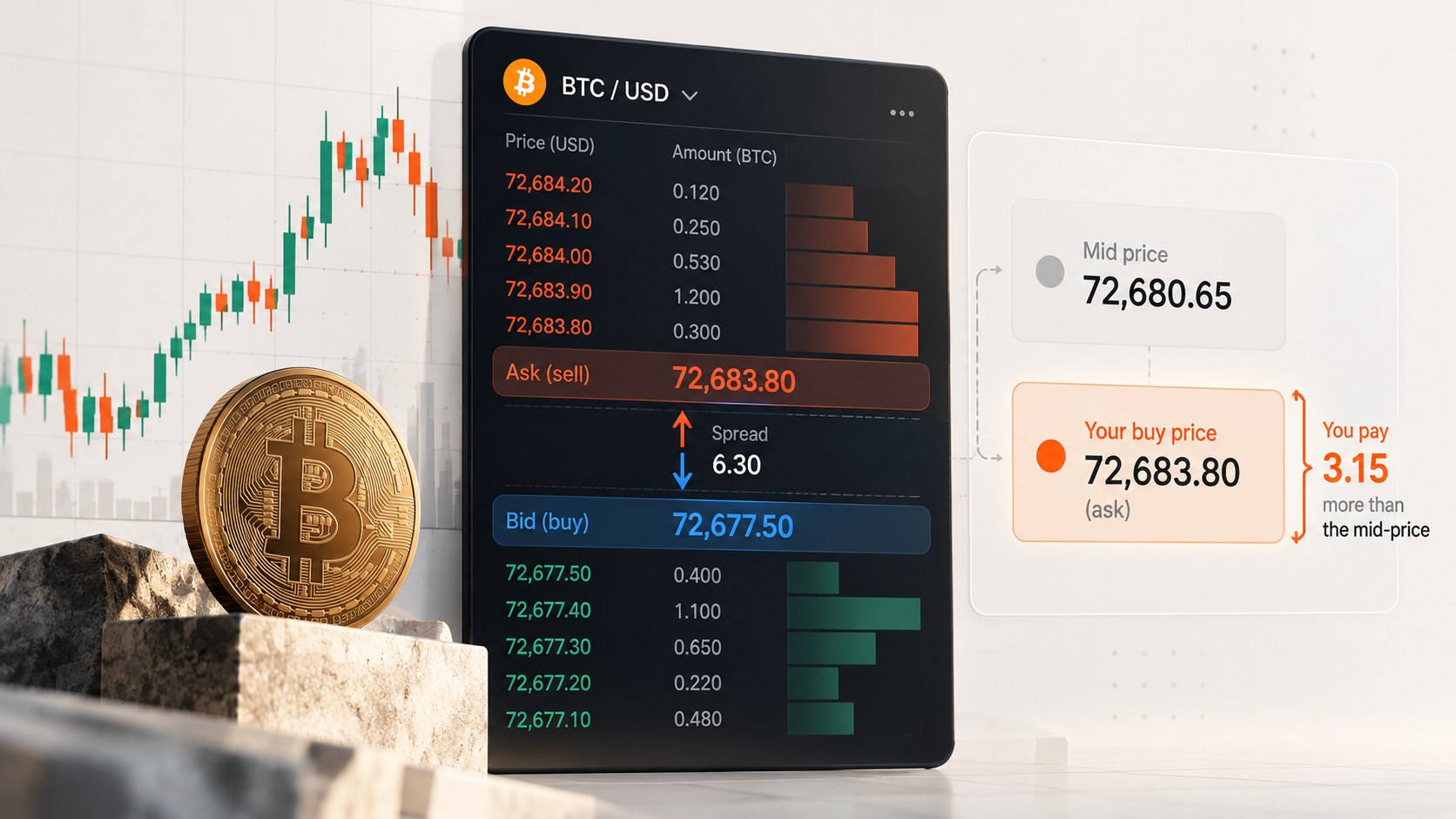
- The bid-ask spread is the gap between the highest price a buyer will pay and the lowest price a seller will accept. An instant buyer generally pays the ask; an instant seller receives the bid.
- A spread is different from a trading fee. A platform can have a low or even zero advertised commission while the execution price still makes the trade expensive.
- Wide spreads are most dangerous in thin or volatile markets because they raise the cost of getting in and make an immediate exit worse. Large orders can also create slippage on top of the spread.
- Retail 'simple buy' screens can include their own quoted spread or pricing cushion. That is not identical to the natural bid-ask spread visible on an exchange order book.
- The useful comparison is all-in execution: how much cash leaves your account, how much crypto you actually receive, and what you could realistically sell it for at the same moment.
The price on the chart is not necessarily the price you can buy at
A crypto app can show Bitcoin at $100,000 without offering to sell you Bitcoin for exactly $100,000.
That number may be a last-traded price, an index price, a midpoint between buyers and sellers, or a reference quote. The actual market still has two sides:
- bid: the highest price someone is currently willing to pay;
- ask: the lowest price someone is currently willing to sell for.
The difference is the bid-ask spread.
If the best bid is $99,900 and the best ask is $100,100, the market is centred around $100,000 but the executable prices are different. An immediate buyer pays roughly $100,100. An immediate seller receives roughly $99,900.
That $200 gap is not a line-item fee. It is part of the market.
Binance Academy’s current explanation describes the same mechanism: market buyers take the lowest available ask, while market sellers take the highest available bid.
A spread becomes real money the moment you cross it
Consider a deliberately simple token:
| Price | |
|---|---|
| Best ask | $10.10 |
| Midpoint | $10.00 |
| Best bid | $9.90 |
The full spread is $0.20, or 2% of the $10 midpoint.
Buy 100 tokens immediately and the position costs $1,010.
If nothing about the market changes and you immediately sell those same 100 tokens, the best bid returns $990.
You have lost $20 before counting any explicit trading fee.
That is why spread matters even if you plan to hold rather than trade actively. You still enter at the buy side of the market. A wider gap means the asset has to move farther in your favour before your position can be sold at a profit.
There is one useful nuance here: the full bid-ask spread is most obvious in an immediate buy-then-sell round trip. On the initial purchase alone, your implicit cost relative to the midpoint is roughly half the spread in a symmetrical order book. Real markets are not always symmetrical, and app-style quotes can add their own pricing spread on top.
“Spread” can mean two different things on a crypto app
This is where crypto fee comparisons get messy.
On an open order book, the spread forms from the best resting buy and sell orders. The exchange may charge a separate maker or taker fee, but the gap between bid and ask comes from the market itself.
A simplified retail buy screen can work differently. The platform may quote you one locked purchase price that already includes a spread or pricing cushion.
Coinbase makes that distinction explicitly in its pricing disclosure. It says simple buy and sell orders include a spread in the quoted price. On Coinbase Advanced, by contrast, Coinbase says no spread is added by Coinbase because the user is interacting directly with the order book.
That does not mean Coinbase Advanced has no bid-ask spread. The market still has bids and asks. It means the platform is not adding the same retail quote spread to the Advanced order-book price.
Wealthsimple provides another useful example. Its crypto execution explanation says the displayed quote serves as a midpoint between the bid and ask, while the final price can differ because of market conditions and applicable trading fees.
So when a platform says “spread,” ask what it means:
- the natural gap in the order book;
- a spread embedded in the platform’s quoted retail price;
- or both affecting the final trade in different ways.
A low trading fee does not guarantee a cheap trade
Suppose two platforms quote the same token around $100.
Platform A charges a visible 0.25% trading fee and gives you an execution price very close to the live market.
Platform B advertises zero commission but quotes the token at $101 when comparable liquid markets are trading around $100.
On a $1,000 purchase, the fee label makes Platform B look cheaper. The amount of crypto received can make it more expensive.
This is why comparing exchanges by one posted fee percentage is incomplete. The practical number is all-in execution cost.
For a purchase, ask:
How much money leaves my account, and how much crypto do I receive?
Then compare that result with a live, liquid reference market at the same moment.
For a round trip, the question becomes harsher:
If I had to sell this position immediately, how much would I get back?
That exposes the combined effect of spread and explicit fees very quickly.
Wide spreads are usually telling you something about liquidity
Tight spreads tend to appear where many buyers and sellers are competing close to the current price. Major trading pairs on deep exchanges can have orders packed tightly around the market.
Thin markets behave differently.
A small token may show a price of $1.00 while the best real buyer is at $0.96 and the cheapest seller is at $1.04. That 8-cent gap is an 8% spread around the midpoint.
A chart can still look perfectly normal. The headline “price” can still be $1.00. But an immediate trade starts with a large disadvantage.
Spreads can widen when:
- the token has few active buyers and sellers;
- the specific trading pair has weak volume or shallow order-book depth;
- the market is moving violently;
- liquidity providers pull back during uncertainty;
- the venue itself has less liquidity than a larger competing exchange;
- a retail quote includes additional room to guarantee a short-lived execution price.
The exit side matters as much as the entry. A token can display a large paper gain while offering very little real liquidity near the displayed price.
Kraken’s Market Price Protection exists for exactly this class of problem: it can stop market orders from filling when the bid/ask spread becomes unusually wide. The feature is a useful reminder that “market order” means taking what the market can actually supply, not receiving a guaranteed chart price.
Spread, fee, slippage and price impact are different costs
They often happen together, which is why they get blurred.
| Cost | What it is | When it appears |
|---|---|---|
| Bid-ask spread | Gap between the best bid and best ask | Exists before your order executes |
| Platform quote spread | Pricing cushion embedded in a retail buy/sell quote | Built into the price shown by some apps |
| Trading fee | Explicit commission or maker/taker charge | Charged by the venue under its fee schedule |
| Slippage | Difference between the price expected and the average price actually received | Appears when execution moves through the market or the market changes |
| Price impact | Price movement caused by your own order | Becomes larger when your order is big relative to available liquidity |
| Network/withdrawal cost | Cost of moving crypto after the trade | Separate from the execution price |
A market order can therefore pay a spread and a trading fee and suffer slippage.
On a decentralized exchange, the mechanics change again. There may be a liquidity pool instead of a conventional order book. Uniswap distinguishes price impact from slippage: price impact is the change caused by your own swap, while slippage is the difference between the expected result and the result actually received.
Different mechanism, same practical lesson: the displayed token price is not enough to tell you what your trade will cost.
Bigger orders can turn a small spread into a bad fill
The top of an order book only tells you the best available price for the quantity sitting there.
Imagine the ask side looks like this:
| Tokens available | Ask price |
|---|---|
| 100 | $10.00 |
| 200 | $10.05 |
| 500 | $10.20 |
| 1,000 | $10.60 |
A market buy for 50 tokens can fill at $10.00.
A market buy for 1,000 tokens cannot. It consumes the cheap offers first, then keeps climbing through more expensive asks. The average execution price ends up above the best ask you saw when you clicked buy.
That difference is slippage caused by limited depth.
This is why the visible spread is only the first liquidity check. For a meaningful order, you also care about how much size exists near the bid and ask.
Limit orders can control price, but they do not make liquidity appear
A limit order lets you set the maximum price you will pay when buying, or the minimum price you will accept when selling.
That can prevent an accidental market fill far away from the price you intended. It does not guarantee a trade.
If the market is asking $10.10 and you place a buy limit at $10.00, you may avoid paying the current ask — but only if a seller eventually agrees to your price. The market can move to $11 without filling you.
A limit order can also still execute immediately if you place it through the existing spread. “Limit” describes your price boundary, not a promise that the order will sit passively in the book or receive a cheaper fee.
The tradeoff is simple: market orders prioritize execution; limit orders prioritize price control.
The fastest way to compare crypto purchase costs
You do not need a professional trading terminal to catch an expensive spread.
Before confirming a purchase:
- Check the final preview. Look at the actual cash total, crypto amount received, explicit fee and any spread disclosure.
- Compare the quoted buy price with a liquid reference market. Use the same asset, same quote currency and roughly the same moment.
- If an order book is available, check bid, ask and depth. A tiny headline fee means little if the market is thin.
- Compare a fixed cash purchase across platforms. “What does $1,000 buy me right now?” is often more revealing than comparing fee pages.
- Include the exit and withdrawal path if they matter to you. A cheap entry can be offset by a wide sell spread, withdrawal fee or network cost later.
The point is not to hunt for a mathematically perfect price every time the market moves.
It is to notice when the difference is material.
A very tight spread may be small relative to normal market movement. A 3% bid-ask spread means an immediate round trip starts roughly 3% behind before explicit fees, even if the headline price itself never moves.
The real price is the executable price
Crypto apps make buying feel like checkout: choose an amount, tap buy, receive coins.
Underneath that screen is still a market.
The useful number is not the prettiest chart price or the smallest advertised fee. It is the price at which your order can actually execute, plus every cost attached to getting there.
A tight spread makes entry and exit more efficient. A wide spread makes both harder. And in thin markets, the spread is often the first visible warning that the headline price is more fragile than it looks.
Sources & reference material
- Coinbase pricing and fees disclosures - cryptoCoinbase Help · Accessed Oct 10, 2026
Coinbase says simple buys and sells can include a spread in the quoted price, while Coinbase Advanced does not add a spread because users interact directly with the order book.
- Bid-Ask Spread and Slippage ExplainedBinance Academy · Accessed Oct 10, 2026
Defines the bid-ask spread as the gap between the highest bid and lowest ask, explains that market orders cross the spread, and distinguishes spread from slippage.
- Understand why your cryptocurrency order filled at a different priceWealthsimple Help Centre · Accessed Oct 10, 2026
Explains that its displayed crypto quote is a midpoint between bid and ask and that the final execution price can differ because of market conditions and trading fees.
- Market Price ProtectionKraken Support · Accessed Oct 10, 2026
Documents protection that can cancel market orders when spreads become unusually wide, illustrating the execution risk of illiquid or volatile markets.
- Price Impact vs Price SlippageUniswap Labs · Accessed Oct 10, 2026
Distinguishes price impact caused by a trader's own swap from slippage between expected and actual execution.