
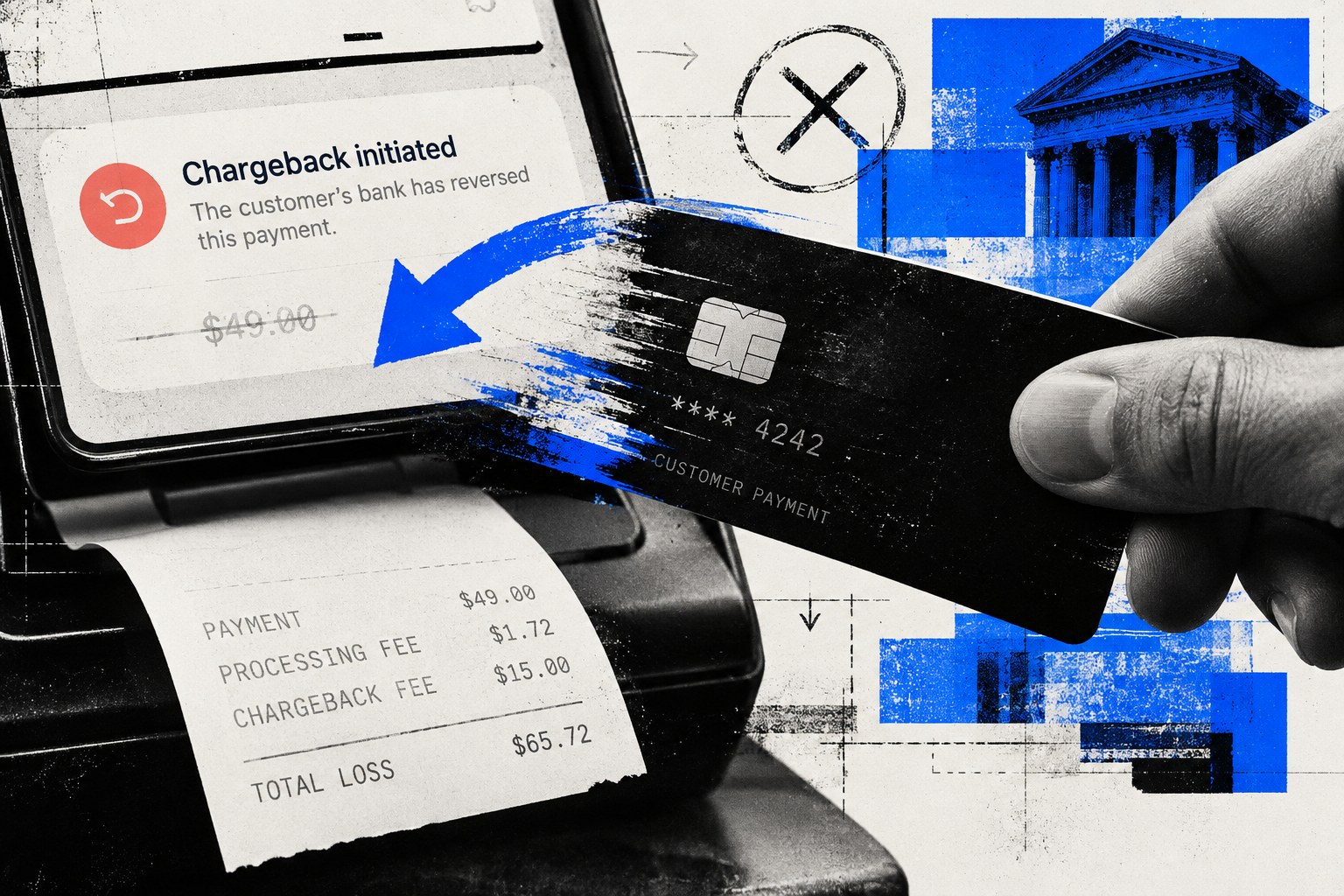
The short version
- A chargeback is not a normal refund. The cardholder disputes a card payment through the issuer, and the disputed amount can be pulled from the merchant while the case is still open.
- The merchant normally has a short deadline to accept or challenge the dispute. Stripe says its response window is usually 7–21 days, while the full lifecycle can take roughly two to three months.
- A strong response attacks the exact dispute reason with evidence: delivery records for non-receipt, account usage for digital services, policy acceptance for cancellations, or distinct receipts for duplicate claims.
- Winning can recover the disputed amount, but it does not make the event free. Provider fees, fulfillment costs and staff time can remain, while dispute activity can still matter to processors and card networks.
- The best chargeback strategy is prevention: recognizable billing descriptors, receipts, fast support, clear refund and cancellation terms, fraud controls and evidence captured before a dispute arrives.
A CA$100 sale can become a CA$115 debit before you have won or lost
From the merchant side, a chargeback starts with an unpleasant asymmetry: the money can move before the argument is finished.
Take a CA$100 card payment processed by a Canadian business using Stripe’s standard pricing. If the cardholder formally disputes that payment, Stripe currently says it debits the disputed amount plus a dispute fee. Its Canadian price sheet lists a CA$15 dispute received fee.
The merchant’s Stripe balance is therefore hit by CA$115 at the start of the case: CA$100 of disputed funds plus the CA$15 fee. That happens before the merchant has proved anything wrong and before the issuer has made a final decision.
If the merchant manually counters the dispute, Stripe currently charges another CA$15 countered fee. That second fee is returned if the merchant wins. The original dispute received fee is not normally returned for Canadian businesses. Custom contracts and other countries can work differently.
That is the core merchant-side reality of a chargeback: it is not just a customer asking for a refund. It is a formal card dispute that can reverse cash flow, add fees and put a deadline on the merchant’s response.
A refund and a chargeback are not the same event
A refund is initiated by the merchant. The business decides that money should go back to the customer and sends the credit through its payment provider.
A chargeback begins on the cardholder’s side, usually when the customer contacts the bank that issued the card. The issuer reviews the complaint and can move the case into the card-network dispute process. Visa describes the merchant as responding through its acquiring side with evidence, while the issuing bank reviews the case and decides whether the reversal stands.
That difference changes almost everything operationally.
| Normal refund | Chargeback |
|---|---|
| Merchant initiates the return of funds | Cardholder initiates a dispute through the issuer |
| Business controls the refund workflow | Merchant must follow a network/provider dispute workflow |
| Usually resolves the sale directly | Can remove disputed funds while the case is still open |
| No evidence packet is normally required | Merchant may need to prove the dispute claim is wrong |
| Does not become a formal card dispute if completed before escalation | Can affect dispute metrics and processor risk review |
Not every complaint becomes a chargeback. Some networks and providers have inquiry or pre-dispute stages where transaction information or a refund can resolve the issue before a formal chargeback is created. Once the formal dispute exists, however, the merchant is inside a rules-driven process rather than a normal customer-service conversation.
What actually happens after the customer disputes a charge
The exact workflow varies by network, issuer, acquirer and payment provider, but the merchant usually sees some version of this sequence.
1. The cardholder contacts the issuer
The customer tells their bank that a charge is unauthorized, duplicated, not received, not as described, tied to a canceled subscription or otherwise disputable.
The issuer does not send the merchant a free-form complaint. The case arrives under a dispute reason or reason code that determines what the merchant is expected to answer.
2. The disputed funds are pulled back
On Stripe, the card network debits Stripe for the disputed payment and Stripe in turn debits the merchant’s balance for the disputed amount plus the applicable dispute fee. Other processors can structure the accounting differently, but the practical effect is similar: the merchant should not assume the sale proceeds remain safely available until a final decision.
This is why a chargeback can produce a negative balance or cash-flow surprise long after the original order looked complete.
3. The merchant gets a deadline
Stripe says merchants usually have 7 to 21 days to respond, depending on the card network. Missing the deadline means losing the opportunity to recover the disputed funds through that response.
The customer can often dispute much later than the merchant can respond. Stripe says card networks typically let cardholders initiate disputes within 120 days of the original payment, with longer windows in some situations, especially where goods or services are delivered in the future.
A sale made months ago can therefore become today’s operational problem.
4. The merchant accepts or challenges the case
If the customer’s claim is valid, accepting the chargeback is often the cleanest outcome.
If the claim is wrong and the merchant can prove it, the merchant can challenge the dispute. Visa commonly calls this representment. Stripe’s interface uses counter dispute.
The important part is not the label. The merchant is sending evidence back through the acquiring/payment-provider side to show why the issuer should overturn the chargeback.
5. The issuer reviews the evidence
Stripe says the issuer usually has around 60 to 75 days to evaluate evidence after it is submitted, and the full dispute lifecycle can take roughly two to three months.
If the merchant wins, the disputed amount is returned. If the merchant loses, the reversal stands.
Some direct acquiring relationships and network cases can have additional pre-arbitration or arbitration stages. A provider can also limit what escalation it supports. Stripe, for example, says it does not support the arbitration phase through its platform.
The reason code is the question you have to answer
A chargeback response is not the place to tell the entire story of the business.
It is a response to a specific claim.
Stripe groups card-network reason codes into practical categories such as fraudulent, duplicate, product not received, product unacceptable, credit not processed and subscription canceled. Each category calls for different evidence.
| Dispute claim | Evidence that can matter |
|---|---|
| Fraud / unauthorized | 3D Secure results where applicable, account history, IP/device data, login or usage records, delivery details, prior undisputed transactions, customer communications |
| Product not received | Carrier tracking, delivery confirmation, signed receipt, collection record, digital download or access logs |
| Not as described / defective | Product listing or service scope shown at purchase, delivery evidence, customer communications, return/refund handling, proof of actual usage where relevant |
| Duplicate | Separate order IDs, itemized receipts, timestamps and proof that the payments were for different purchases, or proof that a duplicate was already refunded |
| Canceled subscription / credit not processed | Cancellation and refund policy, evidence the policy was shown before purchase, cancellation records, refund records and customer correspondence |
The best evidence is evidence that directly makes the stated reason less plausible.
A signed delivery receipt does little for a claim that a subscription was canceled before renewal. A refund policy does little for a true stolen-card transaction. A giant PDF containing every record you have is not automatically stronger than a short file that addresses the exact claim.
Stripe also warns that, in its Dashboard flow, a merchant gets one opportunity to submit the dispute response and cannot edit the evidence after submission. That makes organization matter.
What a chargeback actually costs the merchant
The disputed sale amount is only the obvious line.
A chargeback can combine:
- the reversed payment;
- the provider’s dispute fee;
- an additional response fee, depending on the provider;
- the original card-processing cost already incurred;
- product or inventory already delivered;
- shipping and fulfillment;
- advertising cost used to acquire the customer;
- staff time spent investigating and answering the case;
- the risk cost of higher dispute activity.
The current Stripe Canada example makes the direct payment-provider cost visible.
| Event on a CA$100 disputed payment | Dispute-stage Stripe balance movement |
|---|---|
| Formal dispute received | -CA$100 disputed amount |
| Dispute received fee | -CA$15 |
| Manual counter submitted | -CA$15 countered fee |
| Merchant wins | +CA$100 disputed amount and +CA$15 countered fee returned |
| Merchant loses | No recovery of the disputed amount or either dispute fee |
Source: Stripe Canada pricing and Stripe’s dispute lifecycle documentation, checked 9 October 2026.
So a merchant that wins is not necessarily back to the economics of the original sale. Under this current Canadian Stripe example, the CA$15 dispute received fee remains. The original payment-processing cost, fulfillment and staff time also sit outside the table.
A merchant that loses can be in a worse position than if the sale had never happened at all: the revenue is gone, but some of the costs of earning and fulfilling that revenue remain.
That distinction is one reason gross sales can be a poor proxy for retained money. Our guide to where the money goes after an online sale separates the transaction amount, payment fees and net payment balance, while our Stripe fee breakdown shows how processing costs change with ticket size and payment method.
Winning a chargeback does not make the dispute free
Merchants sometimes treat a successful representment as if the event disappeared.
It usually does not.
On Stripe, all formal disputes count toward its dispute-activity calculations whether the merchant ultimately wins or loses. Card networks maintain their own monitoring programs with their own formulas, thresholds and exclusions. Visa’s current VAMP framework monitors fraud and dispute performance at the acquirer and merchant level, while Mastercard maintains an Excessive Chargeback Program among its merchant compliance programs.
The point is not that one ordinary chargeback puts a healthy business in danger. Visa explicitly describes VAMP as an outlier program.
The point is that prevention and recovery are different jobs.
Winning a dispute can recover money. Preventing the dispute can avoid the fee, the response work and, depending on the network program and how it is resolved, some of the risk signal attached to formal dispute activity.
That is why a business with a rising dispute count should not focus only on its win rate.
Do not fight every chargeback automatically
A merchant’s first reaction is often: the customer is wrong, so fight it.
A better decision starts with four questions:
- Is the claim actually wrong? If the customer was charged twice, never received the order or was entitled to a refund under the merchant’s own terms, accepting the dispute may be the correct result.
- Can you prove the relevant point? Being certain is not the same as having evidence the issuer can use.
- Is the amount worth the response cost? A low-value dispute can consume more in staff time and fees than the realistic recovery.
- Is there a better pre-dispute resolution available? If an alert or inquiry arrives before a formal chargeback, a prompt refund or transaction clarification can sometimes stop escalation.
The useful target is not the highest possible representment rate. It is lower avoidable loss from bad transactions, customer confusion, fulfillment failures and invalid disputes.
The best evidence is collected before the dispute exists
By the time a chargeback lands, the merchant cannot go back and create a clean checkout record, a missing delivery scan or a timestamp showing that the customer accepted a cancellation policy.
For online businesses, the useful evidence trail is built during the normal customer journey.
Keep records that let you reconstruct the sale quickly:
- transaction and order IDs;
- the product or service description shown at purchase;
- the version of the refund or cancellation terms that applied;
- evidence that important terms were disclosed before payment;
- customer account and login history where relevant;
- IP, device or authentication data where lawful and useful;
- shipping, tracking, delivery or collection records;
- digital delivery, download or product-usage logs;
- support messages and refund requests;
- the date and amount of any refund or cancellation.
This is particularly important for digital goods and online services. There may be no box, signature or courier scan. Stripe’s own evidence guidance tells merchants to focus on login, download and usage records when physical shipping evidence does not exist.
A clean evidence trail also makes it easier to recognize when the customer is right and close the case quickly.
Most chargeback prevention is boring operational work
The strongest prevention measures are rarely exotic.
Use a billing descriptor customers can recognize. Send receipts. Make refund and cancellation terms clear before payment. Confirm cancellations. Give customers a support path that is easier than calling their bank. Fix duplicate charges quickly. Send shipping and delivery updates. Keep fraud controls appropriate to the risk of the transaction.
For fraud-sensitive card-not-present payments, authentication can matter too. Stripe notes that some 3D Secure transactions can qualify for liability shift on eligible fraud disputes, although the exact protection depends on the transaction and network rules.
Pre-dispute tools can also buy time. Mastercard described in April 2026 how real-time Ethoca alerts can notify participating merchants when an issuer has confirmed fraud or received a cardholder dispute, giving the merchant a chance to stop fulfillment or resolve the problem before it becomes a chargeback. Visa offers similar pre-dispute products through its dispute-management stack.
A chargeback is often the final stage of a problem that started earlier: stolen-card fraud, an unrecognized billing descriptor, a slow refund, a confusing subscription, missing delivery, bad support or a legitimate purchase being disputed after the fact.
Those causes need different fixes. The merchant-side goal is not to become excellent at paperwork after money disappears. It is to make legitimate disputes rarer and invalid ones easy to prove.
Sources & reference material
- How disputes workStripe · Accessed Oct 09, 2026
Card-dispute lifecycle, merchant balance debits, typical filing and response timing, issuer decision timing, dispute fees and post-decision treatment.
- Respond to disputesStripe · Accessed Oct 09, 2026
Merchant response workflow, limited response window, accept-versus-counter options, evidence submission rules and countered-fee treatment.
- Dispute reason code categoriesStripe · Accessed Oct 09, 2026
Current card-network dispute categories and evidence guidance for fraud, duplicate, product-not-received, product-unacceptable, credit and subscription claims.
- Pricing & Fees — CanadaStripe · Accessed Oct 09, 2026
Current Canadian standard card and dispute pricing, including CA$15 dispute received and CA$15 manually countered fees and refund treatment of the countered fee on wins.
- Chargebacks: navigate, prevent and resolve payment disputesVisa · Accessed Oct 09, 2026
General chargeback flow from cardholder dispute through issuer review, merchant notification, evidence submission and final decision.
- Modernizing payment security: Evolving the Visa Acquirer Monitoring ProgramVisa · Accessed Oct 09, 2026
Visa's current VAMP framework monitors fraud and dispute performance at acquirer and merchant level and is intended to identify outlier activity.
- Mastercard rules and compliance programsMastercard · Accessed Oct 09, 2026
Mastercard merchant compliance resources include the Excessive Chargeback Program and merchant chargeback guidance.
- The best time to stop a chargeback? Before it startsMastercard · Accessed Oct 09, 2026
Merchant-side value of pre-dispute alerts, early resolution, fulfillment stops and reducing chargeback escalation.