
The short version
- A rare skin behaves like a collectible when players agree that its scarcity, appearance, history or variant details make it meaningfully different from ordinary items.
- Digital scarcity is enforced by game rules rather than manufacturing limits, but it can still create collector behavior when supply is restricted and demand is real.
- Counter-Strike makes the pattern unusually visible: named finishes can also differ by wear, randomized pattern placement and other attributes, creating condition- and variant-like distinctions.
- Markets are not required for collectibility, but resale systems make demand visible by attaching prices, listings and liquidity to the hierarchy players already recognize.
- Unlike a physical collectible, a game skin remains dependent on the publisher and platform, which can change acquisition rules, market access or the game itself.
A skin becomes a collectible when the community starts caring about the differences
A weapon skin is not rare because the pixels are difficult to copy. The image file could be reproduced endlessly.
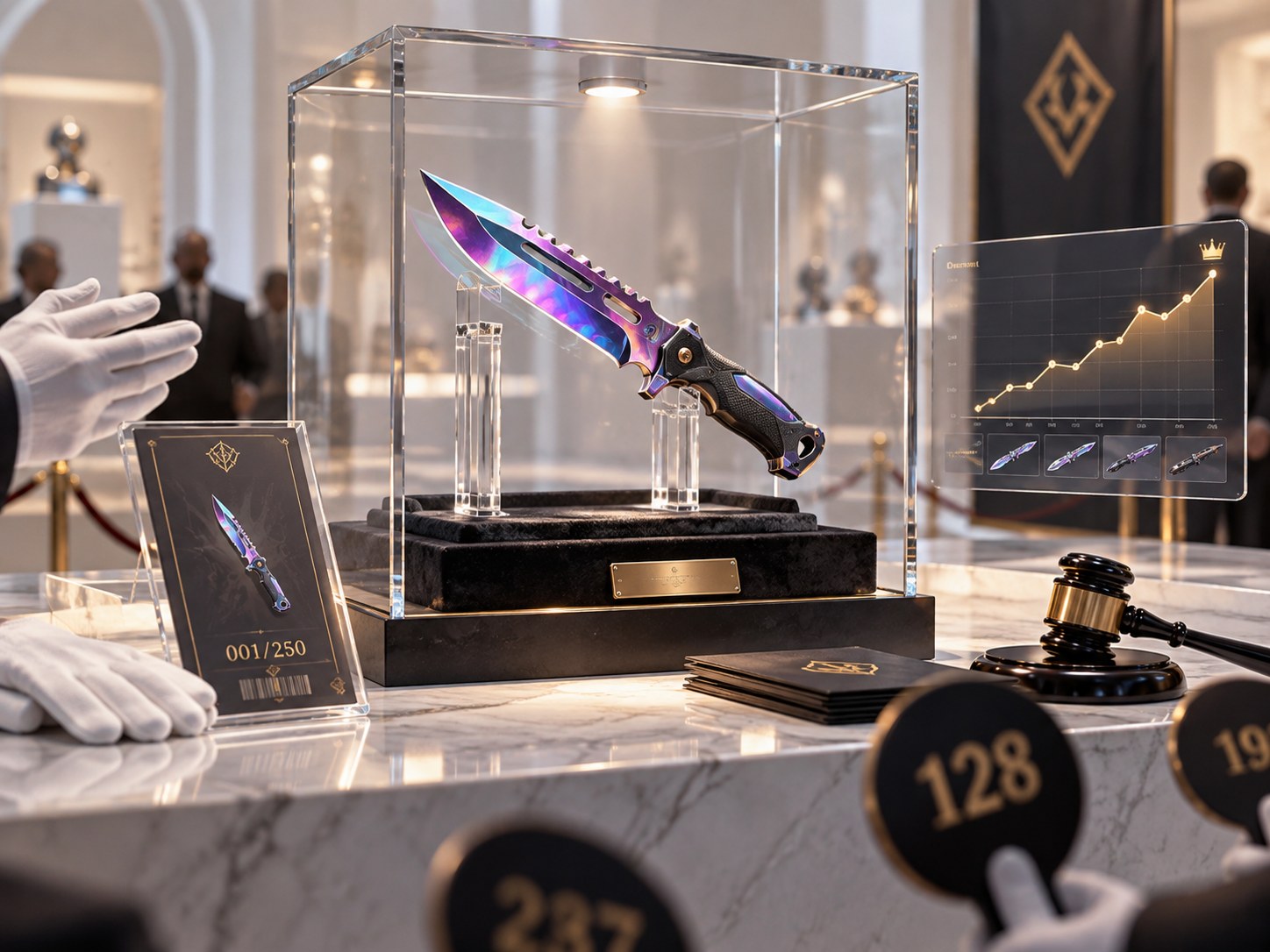
What is scarce is the recognized item inside the game’s system: this finish, on this account, with this rarity, this wear, this pattern, this release history and whatever rules govern how more examples can enter circulation.
That distinction explains why rare skins can behave much more like trading cards, sneakers or watches than like ordinary downloadable graphics.
The collectible is not just the artwork. It is the combination of scarcity, classification, identity and social agreement around the item.
Counter-Strike is the clearest example because it combines all of those ingredients with a long-running secondary market. Valve’s 2013 Arms Deal update explicitly introduced decorated weapons that players could collect, buy, sell and trade. More than a decade later, the most interesting part of the system is not that some skins are expensive. It is that players have developed the same habits found in mature collector markets: ranking variants, chasing condition, remembering old releases, completing sets and arguing over which tiny differences matter.
Scarcity has to be legible before it can become valuable
A scarce object is not automatically a collectible.
There can be only three copies of an ugly, unwanted item and nobody may care. Collector value starts when a community can both recognize the scarcity and desire the thing that is scarce.
Games are unusually good at making scarcity legible. They can assign rarity tiers, restrict an item to a case or event, retire an acquisition path, or make one cosmetic much harder to obtain than another. None of this requires a physical supply constraint. The publisher creates the constraint in software.
Artificial does not mean meaningless.
A limited print run of a trading card is also a designed constraint. The difference is that a game publisher can enforce the limit directly inside the system where the item is used.
Research on digital goods suggests that people respond to those distinctions. A 2025 study in the Journal of the Association for Consumer Research, based on more than 800,000 sales across 40 digital-collectible collections, found that rarer items sold for more on average. That study examined NFTs rather than game skins, so it should not be treated as direct evidence about Counter-Strike. It does support the broader point: digital rarity can create a price premium even when the underlying object is not physically scarce.
But rarity is only the first layer.
The best skin economies create the equivalent of condition, editions and misprints
Collectors rarely stop at “rare versus common.”
A baseball card market cares about year, set, print variation, grading and manufacturing errors. Watch collectors care about reference numbers, dial variants and production eras. Sneaker collectors care about colorway, collaboration, release and condition.
Counter-Strike developed a digital version of that grammar.
Valve’s official weapon-finishes documentation describes skins with wear values that range through condition-like states such as Factory New and Battle-Scarred. Some finish styles also use randomized offsets and rotations, meaning the same named finish can appear differently from one item to another. The system can randomize wear and pattern placement when an item is created. Two examples of the same finish therefore do not have to be collector-equivalent.
That matters more than it sounds.
Once a community begins valuing the exact configuration of an item, the market stops treating every copy as interchangeable. A low-wear example, an unusual pattern placement or a particular premium attribute can become a sub-collectible inside the broader skin.
A 2026 study covering 4,565 Counter-Strike skins found that rarity, quality and premium attributes were associated with higher prices. It also found that expensive rare skins did not automatically generate the best financial returns. The collector hierarchy and the investment hierarchy are not the same thing.
That is a useful distinction because “collectible” is often mistaken for “investment.”
A collectible can be desirable, culturally important and expensive without being a sensible place to park money.
Display turns a private inventory into a social object
A collectible hidden in a drawer can still matter to its owner.
A skin has another advantage: it can be used.
The item appears inside the environment where its community already spends time. The owner does not need to explain the object to everyone around them. Other players who know the game can recognize what they are looking at.
That makes a rare skin partly a display object.
A 2024 Psychology & Marketing paper studying scarcity in virtual gaming products found that supply scarcity could improve evaluations, particularly in online settings with stronger social presence. The researchers also found that encountering other people wearing scarce virtual products could strengthen the effect.
In plain terms: scarcity becomes more meaningful when other people can see it and understand it.
That is why an old or difficult-to-obtain cosmetic can communicate more than taste. Depending on the game and the item, it may imply longevity, luck, money, participation in a specific era or simply deep familiarity with the culture.
The signal only works on people who know the code.
To an outsider, two skins may look almost identical. To a collector, one can carry a completely different story.
A marketplace gives the hierarchy a price
A skin does not need to be tradable to become collectible.
Players can still chase discontinued cosmetics, complete themed sets or value old account items in games that do not allow resale. In those systems, the collection behaves more like an album that cannot be broken apart.
Transferability changes the dynamic because it creates price discovery.
On Steam, eligible items can be listed on the Community Market, and buyers can place buy orders. That gives players a visible record of what sellers are asking and what buyers are willing to pay. The same system also has hard boundaries: Community Market transactions settle in Steam Wallet funds, and those funds cannot be withdrawn to a bank or third-party account.
That is why it is useful to separate three things:
| Layer | What it tells you |
|---|---|
| Rarity | How constrained or uncommon the item is inside the game’s rules |
| Collectibility | Whether players actually care about owning, comparing or completing it |
| Market value | What buyers are willing and able to pay under the available trading system |
They overlap. They are not identical.
A market can make a collectible culture more intense because every preference becomes measurable. A tiny pattern difference that once lived in forum arguments can become a visible price premium.
For a deeper look at that exchange layer, see how the Steam Community Market works.
History can matter as much as appearance
The longer a game survives, the more its cosmetics accumulate context.
An early skin may represent a period when the item system was new. An event cosmetic may point to a tournament, season or collaboration. A discontinued acquisition method can turn an ordinary-looking item into evidence that the account or object passed through an earlier version of the game.
This is familiar collector behavior.
Old Pokémon cards are not valuable because cardboard became technically superior. Vintage watches are not prized because they keep time more accurately than modern quartz watches. Part of the value comes from where the object sits in a history that the community cares about.
Game skins can acquire the same kind of narrative.
Counter-Strike’s decorated-weapon economy began with the Arms Deal update in 2013. That date matters because it gives later collectors an origin point. As the item catalogue grows, early collections are no longer merely alternative textures; they become artifacts from previous phases of the game.
The code did not age.
The culture around it did.
Digital collectibles have one weakness physical collectibles do not: the issuer is still in the room
A physical trading card publisher can release another set, but it cannot remotely alter the rules governing a card already sitting in your house.
Digital collectibles remain dependent on the game operator.
The publisher can change drop systems, trading restrictions, crafting recipes, marketplace access or the game itself. In October 2025, Valve changed Counter-Strike’s Trade Up Contract so that five Covert items could be exchanged for certain knife or glove items. One software update created a new supply path for item categories that collectors already valued.
That does not make the items non-collectible.
It means their scarcity is governed scarcity.
The same company that defines the collectible can also change the rules around it. That is a structural difference from most physical collections and one of the reasons skin prices should never be treated as if rarity were immutable.
A rare skin can have an established market, years of history and intense collector demand while still depending on the continued operation and policies of a private platform.
Rare skins behave like collectibles because players built collector logic around them
The surprising part of digital collecting is not that people pay for pixels.
People have always assigned value to objects whose practical utility is tiny compared with their cultural meaning. A rare card, a first-edition book or a limited sneaker is valuable because a group of people recognizes the object, agrees that some versions matter more than others and has a way to distinguish them.
Rare skins can satisfy the same conditions.
They have catalogues. They have tiers. They have variants. They have condition-like attributes. They can have provenance and history. They can be displayed to an audience that understands the signal. In some games, they can also be exchanged in markets that continuously reveal what that audience is willing to pay.
The strongest skin economies therefore do something more interesting than sell cosmetics.
They create a shared language for deciding which pieces of cosmetic code are ordinary, which are special and which are worth chasing.
That is collectible behavior — even when the collection only exists on a server.
Sources & reference material
- Counter-Strike: Global Offensive — The Arms Deal UpdateValve / Counter-Strike · Accessed Oct 10, 2026
Documents the introduction of more than 100 decorated weapons that players could collect, buy, sell and trade through Counter-Strike and Steam.
- CS2 Workshop Finishes — Weapon Finishes GuideValve / Counter-Strike · Accessed Oct 10, 2026
Documents Counter-Strike weapon-finish wear, randomized pattern placement and other item-level variation that can make examples of the same finish visually distinct.
- Community Market FAQSteam Support · Accessed Oct 10, 2026
Explains eligible item listings, buy orders, Steam Wallet settlement, price limits and the platform boundaries of the Steam Community Market.
- Translating virtual product scarcity in gaming to real-world brand valuePsychology & Marketing · Accessed Oct 10, 2026
Four-study research on virtual gaming products finding that supply scarcity can strengthen evaluations, with effects shaped by online social presence and exposure to others wearing scarce items.
- Uncommonly Rare: Consumers Value Rarity in Digital Goods More in Larger CollectionsJournal of the Association for Consumer Research · Accessed Oct 10, 2026
Analysis of more than 800,000 digital-collectible sales finding that rare items sold for more on average, with the rarity premium increasing in larger collections.
- Videogame Attributes as Alternative InvestmentsThe Quarterly Journal of Finance · Accessed Oct 10, 2026
Study of 4,565 Counter-Strike skins finding that rarity, quality and premium attributes are associated with higher prices, while expensive rare skins do not automatically produce higher returns.
- Counter-Strike 2 Update — Trade Up Contract changesValve / Steam · Accessed Oct 10, 2026
Official update extending Trade Up Contracts so five Covert items can be exchanged for certain knife or glove items, illustrating that publisher rule changes can alter digital-item supply paths.